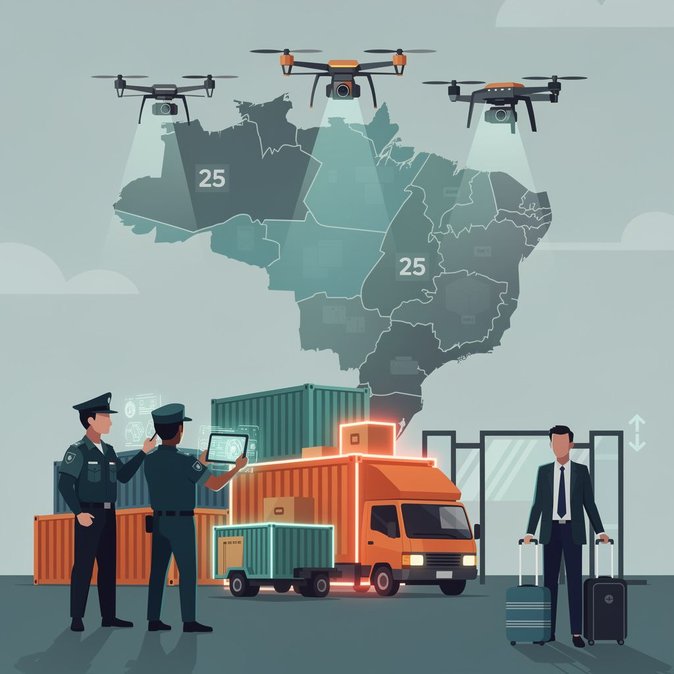
Brazil’s Federal Revenue Service, working with federal and state police forces, announced on 20 November the results of Operation Fronteira, a three-week sweep of 140 municipalities stretching from the Paraguayan border to the Amazon. Officers seized BRL 581 million (about US$ 100 million) worth of smuggled electronics, narcotics, weapons and undeclared cash, a 22 percent increase over the same operation last year. The crackdown deployed 850 agents and 120 inspection vehicles, with drones and mobile X-ray scanners augmenting traditional random checks. In Foz do Iguaçu, cargo scanners discovered 1.2 tonnes of cocaine hidden in sacks of soy destined for Europe, while at the river port of Tabatinga, Amazonas, inspectors intercepted high-end smartphones trafficked from Colombia. Authorities attribute the higher seizure value to improved inter-agency intelligence sharing and to the use of new AI-driven risk-profiling software that flags anomalous cargo manifests in real time. For multinationals, the intensified controls translate into longer dwell times at border crossings. Logistics providers report average clearance delays of 8–12 hours for compliant shipments as officers conduct deeper inspections. Companies shipping high-value electronics should expect selective escorts and prepare detailed proofs of origin to avoid fines. Conversely, legal exporters of agricultural commodities welcomed the removal of illicit cargo that had crowded river ports. The Revenue Service said the operation was partly designed to send “a clear message” ahead of the holiday shopping season, when smuggling traditionally spikes. Officials hinted that similar blitzes would roll out quarterly. Corporate travel managers should alert employees driving across borders—especially at Ciudad del Este and Corumbá—to carry notarised copies of corporate laptops’ purchase invoices, as customs may request proof that electronics are not contraband. In a separate development, Paraguay’s National Customs Directorate confirmed it will mirror Brazil’s risk-profiling algorithm from January 2027, signalling closer regional co-operation on border security.
Source: Agência Brasil