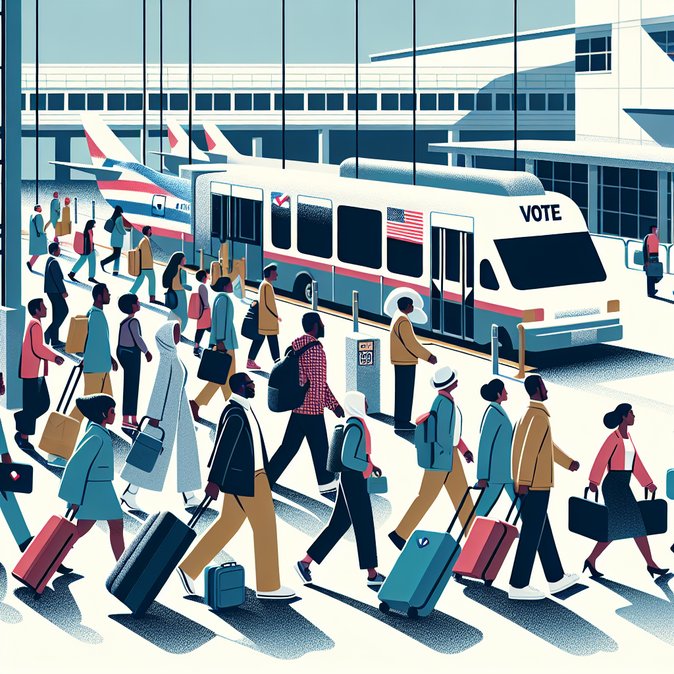
Beyond facilitating passengers, Airport Authority Hong Kong (AAHK) rolled out an employee-centric voting plan on election day (7 December). In a memo echoed in its same-day press release, AAHK authorised on-duty staff—including airline crews, ramp workers and retail employees—to arrive late or leave posts early in order to vote at the Terminal 2 polling station or at home constituencies. Dedicated shuttle buses looped air-side stands, cargo aprons and staff dormitories to the polling booth every 15 minutes.
With roughly 78,000 people working on Lantau’s airport island, the flex-time policy is one of the largest single-employer civic-leave programmes ever implemented in Hong Kong. AAHK said the initiative aligns with its ESG “social” pillar by encouraging democratic participation without compromising safe operations.
![Airport Authority Gives Staff Time-Off and Shuttle Buses to Vote]()
Companies based in the airport’s SkyCity business park adopted similar measures; several logistics firms allowed truck drivers to clock out for a two-hour ‘voting window,’ while Cathay Pacific activated a standby crew pool to cover flight decks.
Labour lawyers note that while Hong Kong law does not mandate paid time off for voting, large transport operators face reputational risk if employees publicly complain about being unable to cast a ballot. AAHK’s approach sets an informal benchmark that other critical-infrastructure employers may feel pressure to follow during future elections or referenda.
From a global mobility standpoint, the case shows how airports—traditionally mobility enablers—are expanding their role into community governance, blending HR policy with transport logistics to keep both people and processes moving.
With roughly 78,000 people working on Lantau’s airport island, the flex-time policy is one of the largest single-employer civic-leave programmes ever implemented in Hong Kong. AAHK said the initiative aligns with its ESG “social” pillar by encouraging democratic participation without compromising safe operations.
Companies based in the airport’s SkyCity business park adopted similar measures; several logistics firms allowed truck drivers to clock out for a two-hour ‘voting window,’ while Cathay Pacific activated a standby crew pool to cover flight decks.
Labour lawyers note that while Hong Kong law does not mandate paid time off for voting, large transport operators face reputational risk if employees publicly complain about being unable to cast a ballot. AAHK’s approach sets an informal benchmark that other critical-infrastructure employers may feel pressure to follow during future elections or referenda.
From a global mobility standpoint, the case shows how airports—traditionally mobility enablers—are expanding their role into community governance, blending HR policy with transport logistics to keep both people and processes moving.
Source: Airport Authority Hong Kong
How VisaHQ can help
VisaHQ simplifies the visa application process for individuals and businesses. Check current travel requirements, prepare the required documents and manage your application online through the VisaHQ Hong Kong portal.More From Hong Kong
View all
Hong Kong International Airport Opens First-Ever Air-side Polling Station for Departing & Arriving Voters

Six Border-Point Polling Stations, Including HZMB and Sheung Shui, Debut for LegCo Election