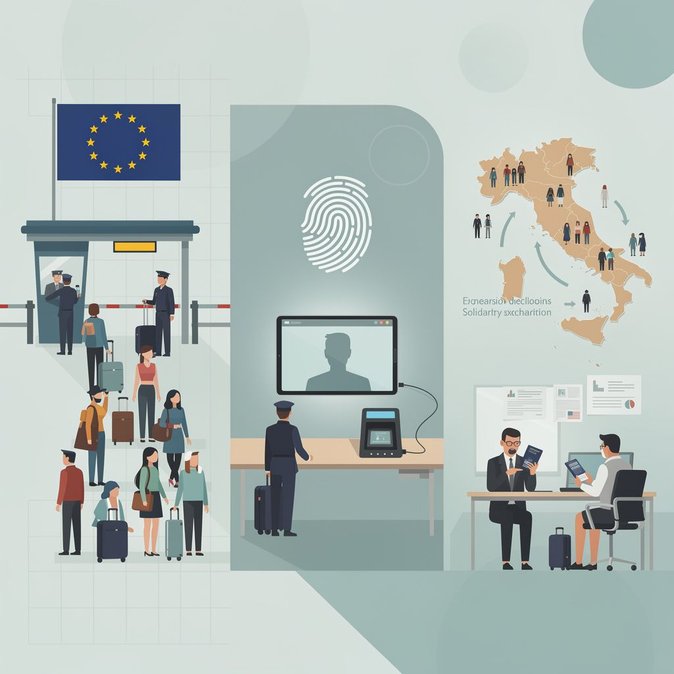
Italy woke up on 12 June 2026 to a radically different European migration framework. At midnight, the long-negotiated Pact on Migration and Asylum entered into force across all 27 EU member states, replacing the Dublin Regulation with a “solidarity mechanism” that obliges countries with fewer asylum claims to support those on the front line. For Italy—historically the bloc’s main first-entry point from the Central Mediterranean—the new rules are more than a legal tweak: they reshape everything from how maritime rescues are processed to how many applications Italian border posts must handle each year (up to 16,032 in the first 12-month cycle, according to a decree approved last week by the Council of Ministers). Practically, travellers will notice faster biometric screening and a mandatory seven-day pre-entry “screening” that includes health, security and vulnerability checks. The Interior Ministry has redeployed 600 additional officers to high-volume crossings such as Ventimiglia, Trieste and Rome-Fiumicino and rolled out new handheld Eurodac scanners to capture fingerprints in the field. Carriers that ferry undocumented passengers now face administrative fines of up to €10,000 per head. For multinational employers the biggest impact is the 12-week deadline for all asylum decisions and the possibility of on-site processing centres near ports and airports. HR departments moving staff into Italy on local contracts will need to budget extra time for work-permit conversions if a candidate’s nationality brings them under the accelerated “border procedure”. Immigration counsel warn that detention periods during the procedure can now reach 18 weeks, potentially delaying onboarding dates. The pact also digitises much of the paperwork. Italy has integrated the new case-management modules into its existing “Portale Immigrazione” and will share real-time statistics with Brussels. While the Commission has earmarked €6.34 billion to support roll-out EU-wide, critics—including NGOs active in Sicily—argue that capacity gaps remain and that deterrence still dominates over integration policies. Business-travel managers should monitor airline and ferry guidance closely: carriers must verify that non-EU passengers cleared pre-entry screening before boarding, or risk being forced to repatriate them at their own expense. The Foreign Ministry urges companies to brief travelling staff on possible secondary inspections and to keep return itineraries and proof of accommodation handy at the border.
Source: Reuters via Internazionale