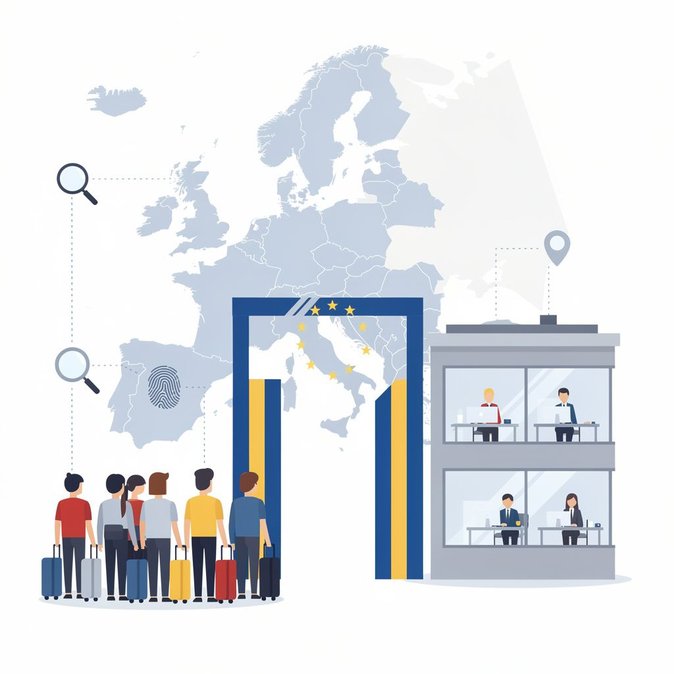
Polish media picked up Deutsche Welle’s analysis early on 13 June, outlining how the newly effective Common European Asylum System (CEAS) will alter the way migrants are processed at the Union’s external borders. Under the reform, travellers from countries with an asylum recognition rate below 20 %—including Iran, Pakistan and Nigeria—will face a mandatory border procedure lasting up to 12 weeks in closed or semi-closed facilities. For companies that regularly send non-EU contractors or technicians to Poland, the most immediate impact is likely to be longer waits for those who transit through sea-border states such as Greece or Italy before flying onward to Warsaw. Once a person has been fingerprinted in the new system, responsibility for examining any protection claim stays with the first-entry country, limiting the possibility to move north and apply again in Poland. Interior-ministry sources in Warsaw say they will push for a rapid upgrade of reception centres along the Belarus and Ukraine frontiers so that Poland can apply the border procedure when its current exemption expires. This includes building secure zones at the Medyka rail crossing and the new terminal in Korczowa-Krakowiec where biometric kiosks for the EU’s Entry/Exit System (EES) are already installed. Legal advisers warn employers that the tighter rules may increase spot checks on residence status inside Schengen. “Foreign staff travelling on short-term visa-free passports should carry proof of accommodation and return tickets,” says Agnieszka Pająk of law firm Dudkowiak & Putyra. Companies are advised to review internal mobility policies and ensure that personnel records can be produced quickly during workplace inspections. Although political controversy remains—Warsaw and Budapest oppose the solidarity levy—the reform enjoys backing from Germany, France and the Commission. With the legislative debate over, attention now turns to execution. Polish business chambers have urged the government to channel EU funds into digitising voivodeship offices so that work-permit backlogs do not grow as asylum officers are redeployed to the border.
Source: Gazeta.pl / Deutsche Welle