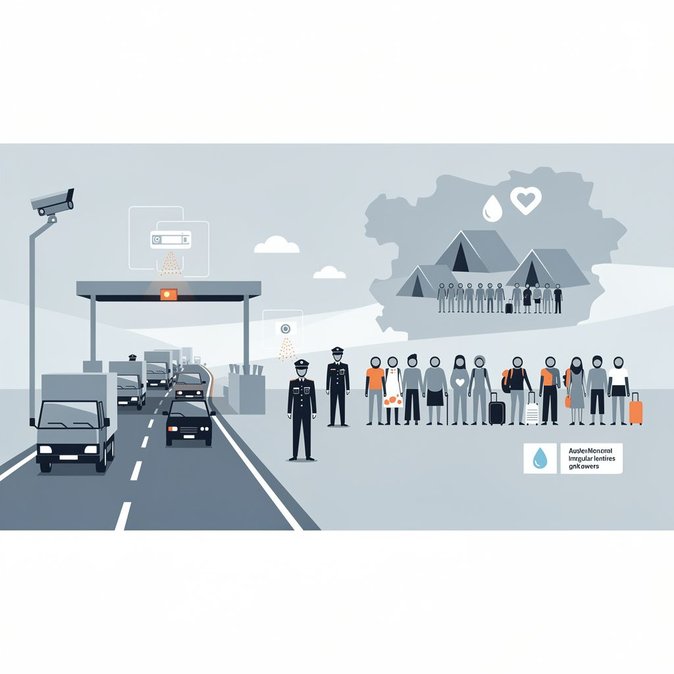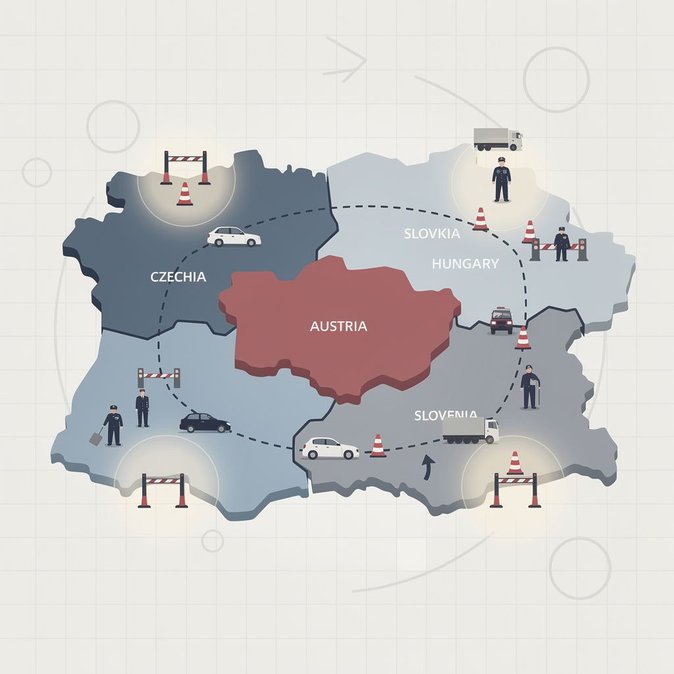
Austria’s Ministry of the Interior has confirmed that the “Grenzraumkontrollen” – the mobile, intelligence-led border-area checks first introduced in December – will be prolonged for another 90 days from 15 June 2026. Interior Minister Gerhard Karner said the decision was taken “to keep pressure on trafficking networks while sparing commuters unnecessary delays.” The regulation applies to the land frontiers with Czechia, Slovakia, Hungary and Slovenia, Austria’s four most-frequented Schengen neighbours. Unlike the older, fixed checkpoints, the current concept creates a moving 30-kilometre control belt patrolled jointly by police and army units. Officials argue that the model has already cut registered irregular crossings by 42 percent since January while allowing cross-border workers to move with minimal disruption. Vienna coordinated the extension with Berlin, whose own flexible controls along the Bavarian/Tyrolean border continue. The move comes only days after the European Commission urged nine Schengen countries – including Austria – to draw up exit strategies for long-running internal controls. Vienna counters that the EU’s new Migration & Asylum Pact, which entered into force last week, makes it even more important to police secondary movements until the bloc’s external-border screening system is fully operational. For globally mobile companies the extension means that drivers on key logistics corridors (e.g., the A5, A2 and A9 motorways) should still plan for ad-hoc stops and identity checks. Employers sending staff on short-term assignments should remind them to carry passports or ID cards at all times, even for routine day-trips within the Schengen Area. Specialist relocation providers report that transferees with appointment letters or proof of accommodation face fewer questions at mobile patrols than tourists without onward documentation. Although the controls remain controversial – Czech and Slovak officials complain of economic friction – Austrian business lobbies broadly support the measure as a temporary safety net while EU-level reforms bed in. The Interior Ministry has promised a fresh evaluation in September, leaving open the possibility of a gradual phase-out if migration numbers stay low.