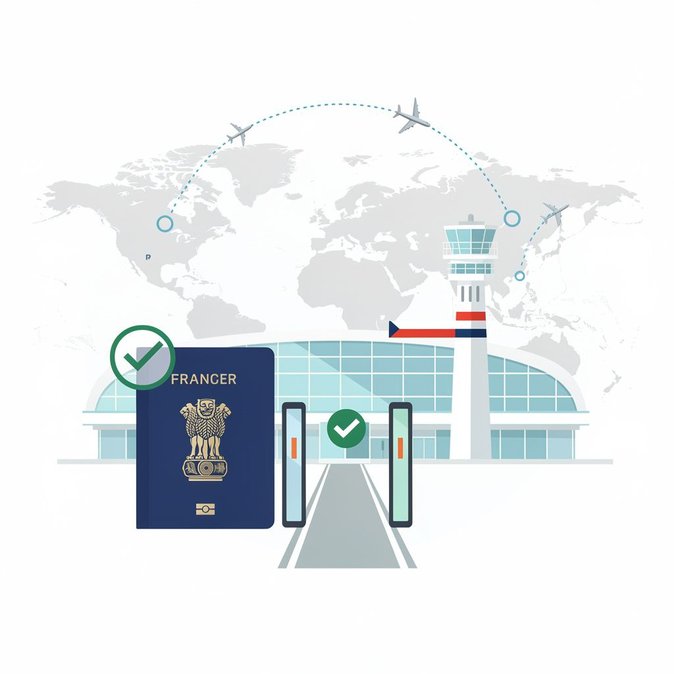
French airports have switched on visa-free air-side transit for Indian citizens, a pledge first announced during President Emmanuel Macron’s January state visit to India. The Ministry of External Affairs confirmed the operational start-date following Prime Minister Narendra Modi’s bilateral talks with Macron in Nice on 15 June 2026. Indian passengers connecting to third-country flights through Paris-Charles de Gaulle, Orly, Nice or other French hubs no longer need an airport transit visa (ATV) provided they remain in the international zone and hold confirmed onward tickets. The development is a boon for global mobility managers: more than 370 one-stop itineraries between India and North America, South America and Africa route through France each week. Removing the €80 ATV saves both cost and a two-to-three-week processing delay, particularly helpful for short-notice assignees and emergency crew rotations. French carriers as well as Air India and Vistara—both members of joint-venture alliances with Air France/KLM—welcomed the move. Lufthansa Group, which secured a similar concession from Germany earlier this month, said that harmonised Schengen-hub policies will strengthen Europe’s appeal as a connecting corridor for South Asian traffic. Corporate travel teams should update booking tools immediately. Travellers must still meet Schengen security criteria: machine-readable passport valid three months beyond transit and proof of ticketed exit within 24 hours. Those exiting the sterile zone into France remain subject to regular short-stay visa rules. Mobility advisers also note that French border staff may request biometric information on arrival, so allowing a minimum 90-minute connection is prudent until data flows stabilise. Strategically, France’s gesture aligns with its goal of doubling bilateral trade to US $32 billion within five years and boosting student exchanges under the Indo-French Innovation Roadmap 2030. Visa-free transit removes a pain-point that deterred Indian tech and SME delegations from routing via Paris, and positions France as a credible competitor to Gulf mega-hubs for Indian long-haul traffic.
Source: The Indian Express