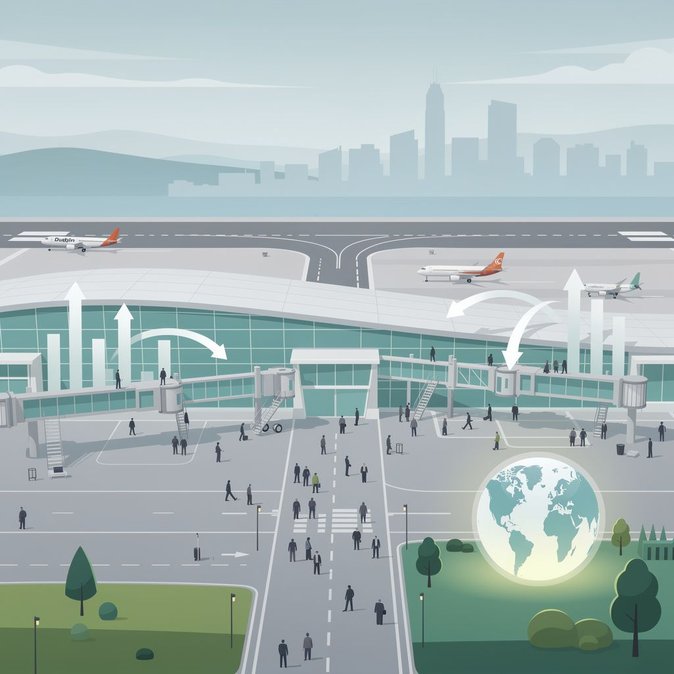
The Irish Government has taken the first concrete step toward lifting the 32-million annual passenger cap that has constrained Dublin Airport’s growth for more than a decade. On 16 June 2026, Minister for Transport Darragh O’Brien secured Cabinet approval to publish the Dublin Airport (Passenger Capacity) Bill 2026 and fast-track it through the Oireachtas before the summer recess. The draft law gives the Minister power to amend or revoke the cap by statutory order once an environmental assessment— to be undertaken by An Coimisiún Pleanála (ACP) — is completed. The Bill also prevents future caps from being imposed by local planning authorities, addressing a major uncertainty flagged by airlines and the airport operator daa.
For international passengers and mobility planners who want to take advantage of the additional connectivity that a larger Dublin Airport will offer, VisaHQ can simplify the visa process. The company’s easy-to-use portal (https://www.visahq.com/ireland/) provides real-time requirements, application management, and expedited processing for Irish visas and travel documents for onward destinations—helping travelers and companies get where they need to go as soon as those extra seats become available.
Removing the ceiling is critical to Ireland’s wider connectivity strategy. Dublin Airport handles 85 % of the Republic’s international passengers and is the country’s main transatlantic hub. Airlines such as Aer Lingus, Ryanair and United have warned that without extra headroom they will divert new aircraft and routes to competing European airports. daa’s separate infrastructure application— now before Fingal County Council— envisages new piers, stands and an Integrated Transport Hub that will allow the airport to grow sustainably to 40 million passengers a year. Business groups welcomed the move, arguing that capacity constraints threaten foreign direct investment and Ireland’s attractiveness for corporate headquarters and high-value manufacturing. Tourism chiefs likewise see the measure as essential to meeting record inbound demand and dispersing visitors across the regions via Dublin’s hub-and-spoke network. For mobility managers, the legislation promises shorter transfer times, greater flight frequency and better resilience against disruption. If enacted on schedule, the environmental review could finish by early 2027, clearing the way for an order lifting the cap ahead of the 2027 summer season.
For international passengers and mobility planners who want to take advantage of the additional connectivity that a larger Dublin Airport will offer, VisaHQ can simplify the visa process. The company’s easy-to-use portal (https://www.visahq.com/ireland/) provides real-time requirements, application management, and expedited processing for Irish visas and travel documents for onward destinations—helping travelers and companies get where they need to go as soon as those extra seats become available.
Removing the ceiling is critical to Ireland’s wider connectivity strategy. Dublin Airport handles 85 % of the Republic’s international passengers and is the country’s main transatlantic hub. Airlines such as Aer Lingus, Ryanair and United have warned that without extra headroom they will divert new aircraft and routes to competing European airports. daa’s separate infrastructure application— now before Fingal County Council— envisages new piers, stands and an Integrated Transport Hub that will allow the airport to grow sustainably to 40 million passengers a year. Business groups welcomed the move, arguing that capacity constraints threaten foreign direct investment and Ireland’s attractiveness for corporate headquarters and high-value manufacturing. Tourism chiefs likewise see the measure as essential to meeting record inbound demand and dispersing visitors across the regions via Dublin’s hub-and-spoke network. For mobility managers, the legislation promises shorter transfer times, greater flight frequency and better resilience against disruption. If enacted on schedule, the environmental review could finish by early 2027, clearing the way for an order lifting the cap ahead of the 2027 summer season.