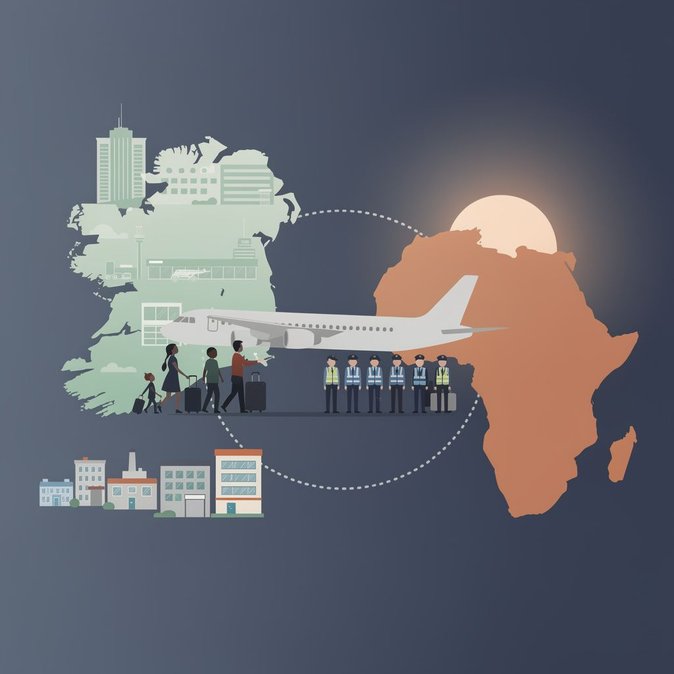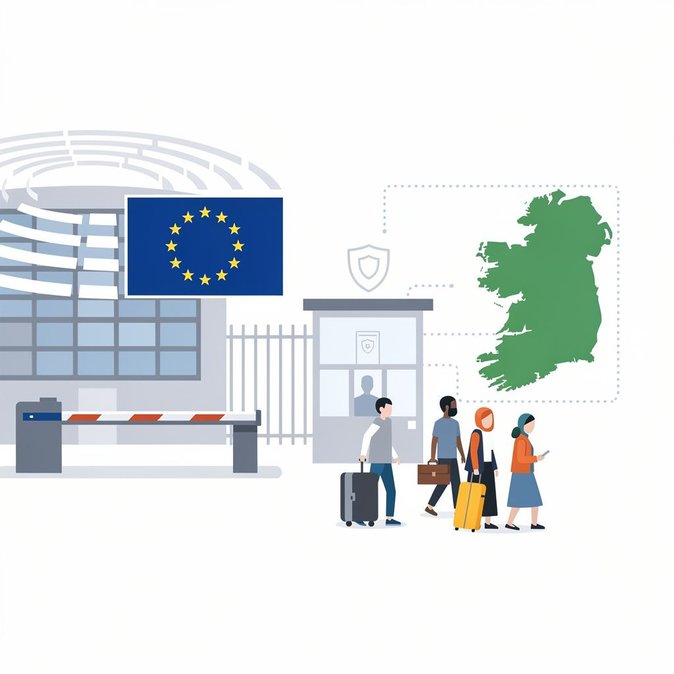
New Irish Times analysis published on 12 June indicates that up to nine in ten asylum seekers reaching the Republic over the past three years first crossed the open land frontier from Northern Ireland. The finding, derived from Garda National Immigration Bureau (GNIB) statistics, intensifies political debate about the Common Travel Area (CTA) at a moment when the EU Migration Pact is reshaping border procedures.
Between 2023 and mid-2026, only a fraction of international-protection applicants arrived directly at Dublin Airport or by ferry. The remainder travelled, often legally, into the United Kingdom and then continued by bus or private car southwards across the invisible border.
Meanwhile, organisations and individuals trying to keep pace with shifting travel rules can turn to VisaHQ for practical assistance. The company’s Ireland portal (https://www.visahq.com/ireland/) offers real-time advice on visa categories, document checklists and application timelines, helping HR departments and cross-border commuters stay compliant amid any forthcoming CTA changes.
Officials note that the pattern accelerated after the UK tightened visitor-visa rules for several African countries in 2025. For businesses, the issue is not merely political. Any move to impose documentary checks along the border could disrupt the seamless flow of goods and commuters on which the all-island economy depends. Cross-border tech hubs in Newry and Letterkenny, for example, employ hundreds of daily commuters whose biometric Irish Residence Permits (IRPs) could be scrutinised under mooted CTA reforms. The Department of Justice insists that it will honour the Good Friday Agreement’s commitment to free movement for British and Irish nationals. Yet senior officials privately concede that targeted ‘intelligence-led’ operations at strategic crossing points may increase over the summer travel peak, starting 20 June. Practical takeaway: HR teams with staff who shuttle between Belfast and Dublin should ensure they carry proof of status—and build in extra travel time—while political negotiations evolve.
Between 2023 and mid-2026, only a fraction of international-protection applicants arrived directly at Dublin Airport or by ferry. The remainder travelled, often legally, into the United Kingdom and then continued by bus or private car southwards across the invisible border.
Meanwhile, organisations and individuals trying to keep pace with shifting travel rules can turn to VisaHQ for practical assistance. The company’s Ireland portal (https://www.visahq.com/ireland/) offers real-time advice on visa categories, document checklists and application timelines, helping HR departments and cross-border commuters stay compliant amid any forthcoming CTA changes.
Officials note that the pattern accelerated after the UK tightened visitor-visa rules for several African countries in 2025. For businesses, the issue is not merely political. Any move to impose documentary checks along the border could disrupt the seamless flow of goods and commuters on which the all-island economy depends. Cross-border tech hubs in Newry and Letterkenny, for example, employ hundreds of daily commuters whose biometric Irish Residence Permits (IRPs) could be scrutinised under mooted CTA reforms. The Department of Justice insists that it will honour the Good Friday Agreement’s commitment to free movement for British and Irish nationals. Yet senior officials privately concede that targeted ‘intelligence-led’ operations at strategic crossing points may increase over the summer travel peak, starting 20 June. Practical takeaway: HR teams with staff who shuttle between Belfast and Dublin should ensure they carry proof of status—and build in extra travel time—while political negotiations evolve.