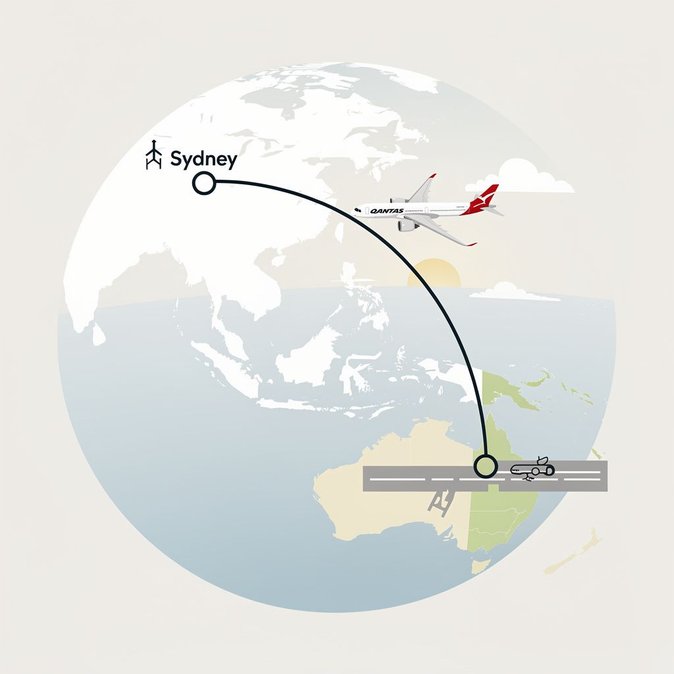
Qantas has firmed up its long-anticipated ultra-long-haul strategy, confirming on 21 June 2026 that the first non-stop commercial flights linking Sydney and London will take off in October 2027. Dubbed “Project Sunrise”, the service will cover almost 17,000 km in roughly 22 hours, eclipsing Singapore Airlines’ Singapore-New York rotation to become the world’s longest regularly-scheduled flight. The announcement follows years of cabin, crew-fatigue and commercial modelling that began before the pandemic and was paused during Australia’s border shutdowns. According to Qantas chief executive Vanessa Hudson, the carrier has ordered 12 specially-adapted Airbus A350-1000ULR aircraft, each fitted with additional centre-tank fuel capacity and configured for just 238 passengers across four classes. A low-density layout – compared with the typical 350-plus seats on a standard A350-1000 – frees up space for a dedicated “wellness zone” where travellers can stretch, hydrate and combat jet-lag during the marathon sector. Research undertaken with the University of Sydney’s Charles Perkins Centre informed the lighting, meal-timing and movement programmes that will be built into the onboard experience. From a network perspective, Project Sunrise targets two lucrative segments: time-sensitive corporate road-warriors and high-yield leisure travellers. Direct London connectivity removes the need for stopovers in Singapore or the Middle East, cutting total journey time by around three hours and eliminating transit-visa and missed-connection risks. Qantas is also finalising discussions with Australian resource and consulting firms that expect to divert premium-cabin traffic to the new flight despite anticipated fares of 10–20 per cent above one-stop competitors. For the wider travel ecosystem, the move signals Australia’s confidence in premium inbound demand despite a high-interest-rate environment and a still-tight labour market. Sydney Airport will refurbish three A 380 gates to handle the heavier-weight A350-1000ULR, while Heathrow’s Terminal 3 will work with Qantas to extend curfew dispensations for the early-morning arrival. Freight forwarders are watching closely: although the passenger configuration limits belly-hold capacity, the route’s speed could make it attractive for time-critical pharmaceutical and tech shipments. Qantas says that once the London service is bedding in, a non-stop Sydney–New York flight will follow in early 2028, with possible Chicago and Cape Town additions under review. Analysts note that government support – particularly streamlined over-fly approvals through the Middle East and Europe – remains a final hurdle, but none expect significant obstacles given the precedent of pre-COVID research flights. For Australian corporates with trans-hemispheric interests, a 22-hour dash from Parramatta to Piccadilly is suddenly within board-meeting reach.
Source: HuffPost España
How VisaHQ can help
VisaHQ simplifies the visa application process for individuals and businesses. Check current travel requirements, prepare the required documents and manage your application online through the VisaHQ Australia portal.More From Australia
View all
Human-rights groups launch 10-day online petition on 21 June urging permanent visas for ‘transitory’ refugees

National AusAlert test hits Queanbeyan as Australia readies new border-crisis warning system