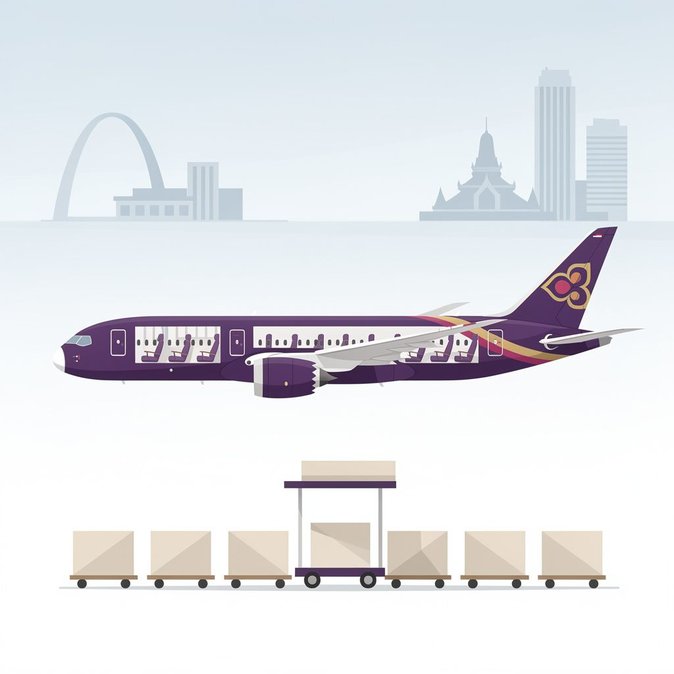
Thai Airways International has quietly boosted capacity on its Brussels–Bangkok service by swapping the usual Boeing 787-8 Dreamliner for the larger 787-9, adding fourteen seats—including eight additional lie-flat business-class pods—on each rotation. The up-gauge, which took effect last week but was formally confirmed on 22 June, comes ahead of the Southeast Asian carrier’s broader European summer offensive that also includes a new daily Amsterdam connection.
Before locking in seats on the beefed-up service, remember that Belgian nationals still need the correct visa for business travel to Thailand. VisaHQ’s Brussels team can fast-track Thai visa applications entirely online—handling employer letters, passport couriering and Thai e-visa submissions—so travel managers can focus on itineraries rather than paperwork. Check out the options at https://www.visahq.com/belgium/
For Belgian corporates, the enhancement delivers a welcome increase in premium-class inventory on one of the most sought-after non-stop links to Asia. According to travel-management company BCD Belgium, demand for Belgium-Thailand itineraries is already running 18 % above 2025 volumes, driven by pharmaceutical, engineering and agri-food exporters restarting in-person visits to Thai manufacturing hubs around Chonburi and Rayong. The 787-9 also offers improved freight capacity—crucial for temperature-controlled pharma cargo—thanks to its longer belly hold. Brussels Airport’s cargo village has seen South-East Asia-bound volumes grow steadily since the EU-Thailand free-trade talks resumed last year, and logistics firms such as DHL Global Forwarding expect the additional lower-deck space to shave a day off some cross-dock routings. Travel buyers should note that Thai Airways has not yet adjusted its published fare classes; however, the greater seat count is already feeding lower spot-prices in the mid-week premium cabin, which could prove valuable during the busy Q3 conference season in Bangkok. The carrier hinted that, should load factors stay above 85 %, it might consider restoring a second weekly frequency dropped during the pandemic. From a mobility-policy perspective, the change highlights the importance of monitoring equipment swaps, not just headline flight frequencies. Larger, more modern aircraft can alter safety-ratings, carbon footprints and cost structures—key inputs for HR and procurement teams when updating preferred-supplier lists for 2027.
Before locking in seats on the beefed-up service, remember that Belgian nationals still need the correct visa for business travel to Thailand. VisaHQ’s Brussels team can fast-track Thai visa applications entirely online—handling employer letters, passport couriering and Thai e-visa submissions—so travel managers can focus on itineraries rather than paperwork. Check out the options at https://www.visahq.com/belgium/
For Belgian corporates, the enhancement delivers a welcome increase in premium-class inventory on one of the most sought-after non-stop links to Asia. According to travel-management company BCD Belgium, demand for Belgium-Thailand itineraries is already running 18 % above 2025 volumes, driven by pharmaceutical, engineering and agri-food exporters restarting in-person visits to Thai manufacturing hubs around Chonburi and Rayong. The 787-9 also offers improved freight capacity—crucial for temperature-controlled pharma cargo—thanks to its longer belly hold. Brussels Airport’s cargo village has seen South-East Asia-bound volumes grow steadily since the EU-Thailand free-trade talks resumed last year, and logistics firms such as DHL Global Forwarding expect the additional lower-deck space to shave a day off some cross-dock routings. Travel buyers should note that Thai Airways has not yet adjusted its published fare classes; however, the greater seat count is already feeding lower spot-prices in the mid-week premium cabin, which could prove valuable during the busy Q3 conference season in Bangkok. The carrier hinted that, should load factors stay above 85 %, it might consider restoring a second weekly frequency dropped during the pandemic. From a mobility-policy perspective, the change highlights the importance of monitoring equipment swaps, not just headline flight frequencies. Larger, more modern aircraft can alter safety-ratings, carbon footprints and cost structures—key inputs for HR and procurement teams when updating preferred-supplier lists for 2027.