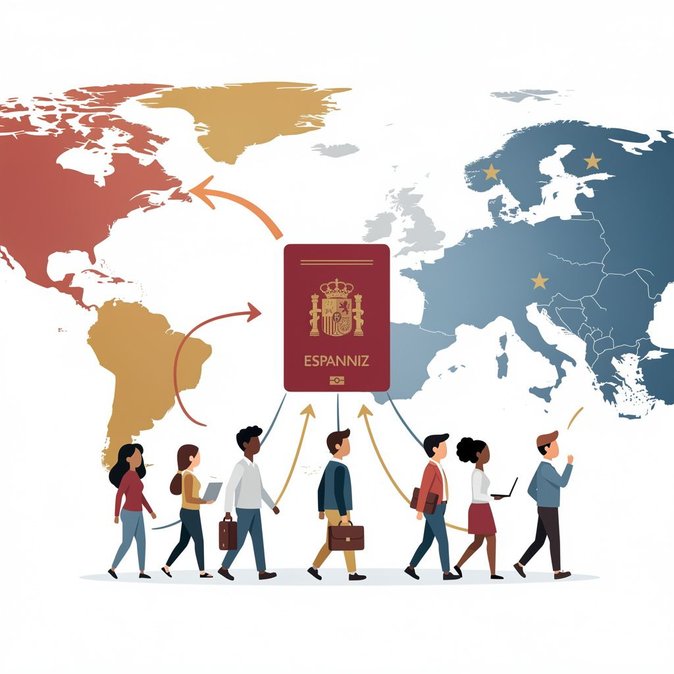
In a televised interview and subsequent press briefing on 22 June, Partido Popular (PP) president Alberto Núñez Feijóo accused Spain’s Socialist government of turning the so-called "Ley de Nietos" into a “passport factory” for millions of descendants of Spanish emigrants. Feijóo claims that a Justice-ministry instruction has stretched eligibility well beyond the original exile-reparation intent of the 2022 Memory Law, resulting in 2.5 million applications and more than 545,000 approvals to date. The law allows foreign-born children and grandchildren of Spaniards to obtain citizenship without prior residence.
For individuals and corporate HR teams navigating these shifting requirements, VisaHQ offers end-to-end support—from securing apostilled documents to scheduling consular appointments—and provides real-time updates on Spain’s citizenship and visa processes. Its Spain portal (https://www.visahq.com/spain/) consolidates eligibility checklists, fee calculators and expert assistance, helping applicants avoid costly delays.
Consulates in Argentina, Mexico and Uruguay report month-long appointment backlogs, and the Foreign Ministry has redeployed staff to handle demand. The PP argues that accelerated citizenship inflates the overseas electoral roll—traditionally favourable to the governing PSOE—and could influence the 2027 general election. Government sources retort that the process merely corrects historical injustices and that new nationals contribute economically and culturally. From a global-mobility perspective, the controversy has practical ramifications. Spanish nationality grants full EU free-movement rights, making the passport attractive to Latin-American professionals who already work remotely for European firms. Corporations may see a rise in employees acquiring Spanish citizenship to facilitate intra-EU assignments, while consular bottlenecks could delay other visa categories as staff are diverted. Legal advisers caution that documentation standards remain high—apostilled birth certificates and criminal-record reports are mandatory—and that applicants must formalise citizenship at a Spanish civil registry within one year of approval. HR departments with large Latin-American talent pools should track developments: if political pressure leads to tighter rules, pending applications could face new hurdles.
For individuals and corporate HR teams navigating these shifting requirements, VisaHQ offers end-to-end support—from securing apostilled documents to scheduling consular appointments—and provides real-time updates on Spain’s citizenship and visa processes. Its Spain portal (https://www.visahq.com/spain/) consolidates eligibility checklists, fee calculators and expert assistance, helping applicants avoid costly delays.
Consulates in Argentina, Mexico and Uruguay report month-long appointment backlogs, and the Foreign Ministry has redeployed staff to handle demand. The PP argues that accelerated citizenship inflates the overseas electoral roll—traditionally favourable to the governing PSOE—and could influence the 2027 general election. Government sources retort that the process merely corrects historical injustices and that new nationals contribute economically and culturally. From a global-mobility perspective, the controversy has practical ramifications. Spanish nationality grants full EU free-movement rights, making the passport attractive to Latin-American professionals who already work remotely for European firms. Corporations may see a rise in employees acquiring Spanish citizenship to facilitate intra-EU assignments, while consular bottlenecks could delay other visa categories as staff are diverted. Legal advisers caution that documentation standards remain high—apostilled birth certificates and criminal-record reports are mandatory—and that applicants must formalise citizenship at a Spanish civil registry within one year of approval. HR departments with large Latin-American talent pools should track developments: if political pressure leads to tighter rules, pending applications could face new hurdles.