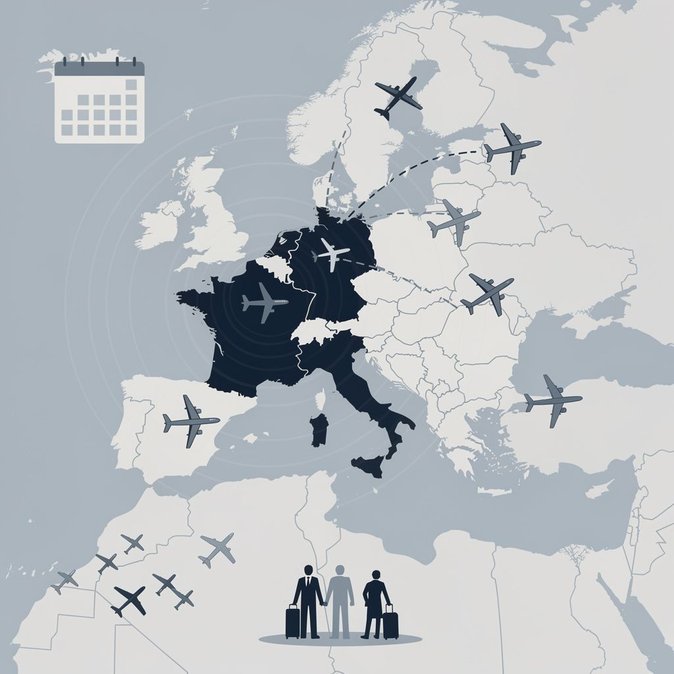
France’s largest air-traffic controllers’ union, the SNCTA, formally filed notice on 24 June that its members will stage a four-day national strike from 7 to 10 October. According to the union, the walk-out aims to force the government to accelerate recruitment and technology upgrades promised after last year’s record summer delays. Industry group Airlines for Europe warns that the stoppage could force carriers to cancel or reroute up to 1,800 flights crossing French airspace, affecting services not only to and from France but also key North-South corridors between the UK, Spain, Italy and Greece. French skies are unusually critical to European traffic flows: roughly a third of continental overflights pass through French-controlled sectors each day. During a one-day “warning” strike by two smaller unions earlier on 24 June, Eurocontrol data showed 933 cancellations and average delays of 37 minutes per flight. Airlines fear a four-day stoppage in October will coincide with the end of corporate travel budgeting cycles and autumn trade fairs, raising the risk of cascading delays across Europe. Ryanair alone estimates it will have to cancel about 1,800 sectors – many of them business-critical early-morning rotations – if no minimum-service agreement is reached. The Directorate-General for Civil Aviation (DGAC) says it will publish mandatory flight-reduction notices (“Notam strike”) at least 72 hours in advance, but concedes that staffing shortfalls in Marseille and Reims upper-air centres leave “little room for dynamic rerouting”. Business-travel managers are therefore being advised to build contingency time into October itineraries, consider rail alternatives on short-haul routes such as Paris–Brussels or Paris–Zurich, and review force-majeure clauses in hotel and event contracts. For multinationals operating time-critical supply chains, the planned October action is also a reminder of structural labour-relations risk: French air-traffic controllers have staged work stoppages in 22 of the last 30 months. Companies with frequent intra-EU travel should ensure travellers are enrolled in real-time disruption alert services and that meetings are booked with flexibility on arrival days. The strike notice remains withdrawable, and talks at the Ministry of Transport are scheduled for mid-July, but employers should plan on the assumption that significant disruption is likely.
Source: AK&M Newswire