India has quietly strengthened the eastern end of its maritime border. A Ministry of Home Affairs (MHA) notification dated 22 June has added West Bengal’s Haldia Dock Complex to the list of authorised immigration check-points under the Immigration & Foreigners Act 2025. Economic Times Supply Chain confirmed the change when the Kolkata-based Syama Prasad Mookerjee Port (which manages Haldia) received the formal gazette entry on 24 June.
Why Haldia? Situated 120 km south-west of Kolkata on the Hooghly River, the port is already a bulk-cargo workhorse for eastern and north-eastern India. Cruise operators have shown interest in using Haldia as an embarkation hub for river and coastal voyages, but the lack of on-site immigration facilities forced passengers and crew to clear formalities in Kolkata.
As foreign crew members, tourists and business travellers begin routing their itineraries through Haldia, they will still need the correct Indian visas in hand. VisaHQ (https://www.visahq.com/india/) simplifies that paperwork by guiding applicants through e-Visa, business, tourist and specialised crew-visa processes, providing real-time status updates and support so that clearance at newly authorised checkpoints like Haldia remains hassle-free.
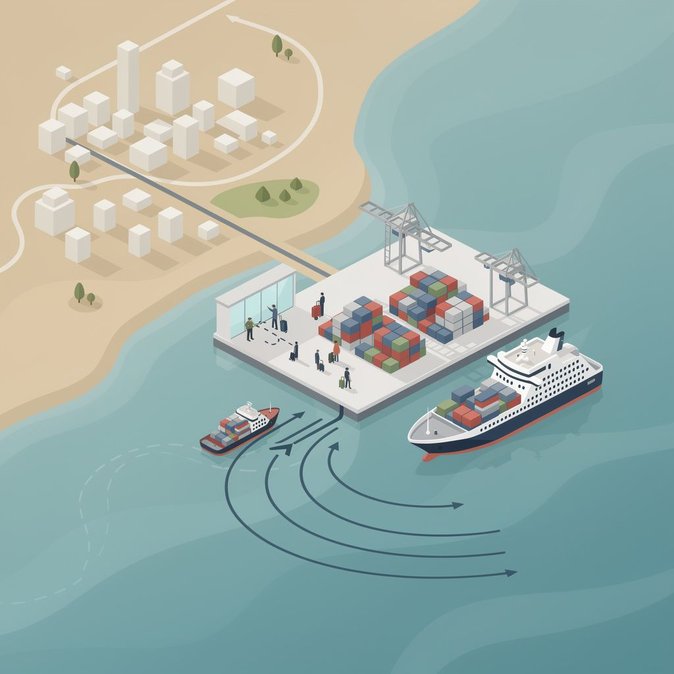
The new status removes that bottleneck, allowing direct embarkation/disembarkation of foreign ships, crew changes and even limited passenger services without detouring upriver. From a regulatory perspective, Haldia becomes the 41st sea-port on the national immigration grid. The move complements Sagarmala and PM GatiShakti port-modernisation schemes that push customs and immigration technology further down the coastline, distributing traffic away from Mumbai, Chennai and Kochi. In May the MHA added Dahej, Sikka and Tuna Tekra in Gujarat, signalling that smaller commercial ports must now be “border ready” to handle crew rotations, super-yacht clearances and project-cargo specialists who fly in on business visas. Shipping lines and manning agencies expect tangible gains. Crew managers can now plan direct sign-on/sign-off at Haldia instead of busing seafarers 140 km to Netaji Subhas International Airport for clearance. Logistics players foresee faster turnaround for vessels calling Bangladesh, Myanmar and Thailand feeder routes. Tourism operators lobbying for an international river-cruise corridor from Varanasi to the Bay of Bengal say the immigration window removes a key procedural hurdle. The upgrade also places new demands on local authorities: biometric e-gates, Advance Passenger Information System (APIS) feeds to Delhi, and 24×7 Foreigners’ Regional Registration Office (FRRO) coverage must all be in place before the first direct call. The port trust has six months to operationalise staff and infrastructure. If executed well, Haldia could become a template for decentralising India’s maritime border controls—critical for a coastline that now handles a quarter of the country’s container throughput.
Why Haldia? Situated 120 km south-west of Kolkata on the Hooghly River, the port is already a bulk-cargo workhorse for eastern and north-eastern India. Cruise operators have shown interest in using Haldia as an embarkation hub for river and coastal voyages, but the lack of on-site immigration facilities forced passengers and crew to clear formalities in Kolkata.
As foreign crew members, tourists and business travellers begin routing their itineraries through Haldia, they will still need the correct Indian visas in hand. VisaHQ (https://www.visahq.com/india/) simplifies that paperwork by guiding applicants through e-Visa, business, tourist and specialised crew-visa processes, providing real-time status updates and support so that clearance at newly authorised checkpoints like Haldia remains hassle-free.
The new status removes that bottleneck, allowing direct embarkation/disembarkation of foreign ships, crew changes and even limited passenger services without detouring upriver. From a regulatory perspective, Haldia becomes the 41st sea-port on the national immigration grid. The move complements Sagarmala and PM GatiShakti port-modernisation schemes that push customs and immigration technology further down the coastline, distributing traffic away from Mumbai, Chennai and Kochi. In May the MHA added Dahej, Sikka and Tuna Tekra in Gujarat, signalling that smaller commercial ports must now be “border ready” to handle crew rotations, super-yacht clearances and project-cargo specialists who fly in on business visas. Shipping lines and manning agencies expect tangible gains. Crew managers can now plan direct sign-on/sign-off at Haldia instead of busing seafarers 140 km to Netaji Subhas International Airport for clearance. Logistics players foresee faster turnaround for vessels calling Bangladesh, Myanmar and Thailand feeder routes. Tourism operators lobbying for an international river-cruise corridor from Varanasi to the Bay of Bengal say the immigration window removes a key procedural hurdle. The upgrade also places new demands on local authorities: biometric e-gates, Advance Passenger Information System (APIS) feeds to Delhi, and 24×7 Foreigners’ Regional Registration Office (FRRO) coverage must all be in place before the first direct call. The port trust has six months to operationalise staff and infrastructure. If executed well, Haldia could become a template for decentralising India’s maritime border controls—critical for a coastline that now handles a quarter of the country’s container throughput.