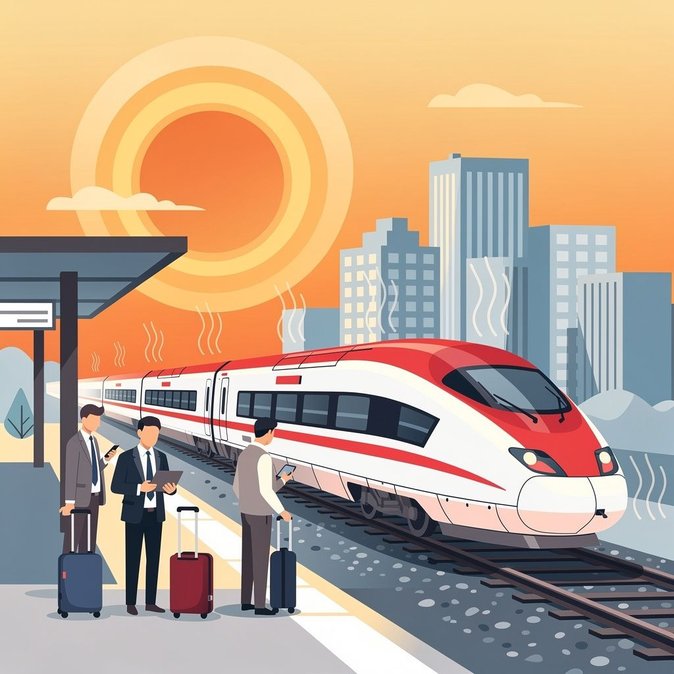
With the German Weather Service forecasting temperatures above 40 °C for the last week of June, Deutsche Bahn (DB) on 25 June introduced an extraordinary goodwill policy: long-distance tickets bought on or before 23 June for travel up to 30 June can be cancelled or used flexibly on another day at no extra cost. Normally, fully flexible tickets carry a surcharge and discounted Sparpreise are non-refundable once the day of travel has begun. DB says the measure is designed to protect passengers and staff from heat-related health risks and to reduce stress on infrastructure. Overheated overhead lines, rail buckling and air-conditioning failures are recurrent problems during German heatwaves; offering cancellations should thin passenger numbers and give crews more room to react.
For travellers who need to rearrange their schedules at short notice, VisaHQ can help secure any necessary visa amendments or Schengen documentation, ensuring compliance even when plans change because of the heatwave. The company’s online platform and experts (https://www.visahq.com/germany/) streamline paperwork so mobility managers can concentrate on rebooking transport and accommodation without worrying about border formalities.
Extra water supplies and mobile support teams have been deployed at the hubs of Berlin-Hbf, Frankfurt-M Hbf and München-Hbf. The unprecedented policy is a signal to large employers that duty-of-care considerations are becoming integral to travel policies. Mobility managers can expect higher short-notice re-booking volumes and should ensure that self-booking tools recognise the new flexibility. Companies with factory shutdowns or field-service commitments may want to reschedule trips altogether to avoid productivity losses from heat-induced slow-downs and possible infrastructure failures. The move also feeds into Germany’s climate-adaptation debate. As heatwaves become more frequent, transport operators face pressure to climate-proof tracks and rolling stock. DB’s gesture buys time, but experts argue that stronger investment in resilient infrastructure – such as white-painted rails, improved catenary cooling and upgraded carriage HVAC systems – is essential if rail is to remain the backbone of sustainable corporate mobility.
For travellers who need to rearrange their schedules at short notice, VisaHQ can help secure any necessary visa amendments or Schengen documentation, ensuring compliance even when plans change because of the heatwave. The company’s online platform and experts (https://www.visahq.com/germany/) streamline paperwork so mobility managers can concentrate on rebooking transport and accommodation without worrying about border formalities.
Extra water supplies and mobile support teams have been deployed at the hubs of Berlin-Hbf, Frankfurt-M Hbf and München-Hbf. The unprecedented policy is a signal to large employers that duty-of-care considerations are becoming integral to travel policies. Mobility managers can expect higher short-notice re-booking volumes and should ensure that self-booking tools recognise the new flexibility. Companies with factory shutdowns or field-service commitments may want to reschedule trips altogether to avoid productivity losses from heat-induced slow-downs and possible infrastructure failures. The move also feeds into Germany’s climate-adaptation debate. As heatwaves become more frequent, transport operators face pressure to climate-proof tracks and rolling stock. DB’s gesture buys time, but experts argue that stronger investment in resilient infrastructure – such as white-painted rails, improved catenary cooling and upgraded carriage HVAC systems – is essential if rail is to remain the backbone of sustainable corporate mobility.