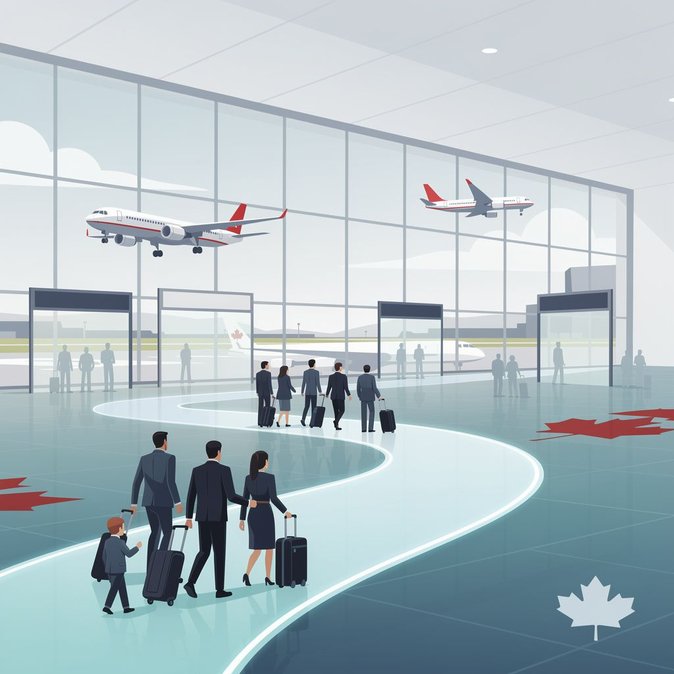
The Canada Border Services Agency (CBSA) has rolled out its “Free Flow International-to-International Transit” program, allowing eligible passengers to bypass in-person customs screening when connecting through Vancouver, Toronto-Pearson (T1) or Montréal-Trudeau. Announced on June 26, 2026, the initiative follows a multi-year pilot and a Canada Gazette consultation on associated regulatory amendments. Under the new model, airlines transmit passenger data directly to CBSA so officers can conduct risk assessments behind the scenes. Travellers must hold confirmed onward tickets departing within 24 hours and retain the visas or eTAs required for their final destination.
For travellers who want to be absolutely certain they have the correct visa or eTA in hand before making a tight connection, VisaHQ can help. Its online service (https://www.visahq.com/canada/) lets passengers check real-time entry requirements, complete digital applications, and arrange expedited processing for hundreds of destinations—including Canada—so the documents CBSA expects are sorted well before take-off.
Those meeting the criteria proceed straight to their next gate, shaving an estimated 30–60 minutes off typical connection times. Airport authorities expect the change to boost Canada’s competitiveness as a trans-Pacific and trans-Atlantic hub, particularly for business travellers who value short layovers. Vancouver International Airport projects a 12 percent rise in through-traffic capacity once additional self-transfer corridors open later this year. CBSA says other airports can apply to join the program, provided they invest in secure passenger-segmentation infrastructure. The agency emphasises that high-risk passengers will still be pulled for secondary screening and that traditional customs processing remains in place for travellers entering Canada. Corporate travel managers should update itinerary-planning tools to reflect the new connection rules and remind employees that transit passengers remain responsible for meeting visa requirements of their destination country; CBSA will not intervene if onward entry is refused.

For travellers who want to be absolutely certain they have the correct visa or eTA in hand before making a tight connection, VisaHQ can help. Its online service (https://www.visahq.com/canada/) lets passengers check real-time entry requirements, complete digital applications, and arrange expedited processing for hundreds of destinations—including Canada—so the documents CBSA expects are sorted well before take-off.
Those meeting the criteria proceed straight to their next gate, shaving an estimated 30–60 minutes off typical connection times. Airport authorities expect the change to boost Canada’s competitiveness as a trans-Pacific and trans-Atlantic hub, particularly for business travellers who value short layovers. Vancouver International Airport projects a 12 percent rise in through-traffic capacity once additional self-transfer corridors open later this year. CBSA says other airports can apply to join the program, provided they invest in secure passenger-segmentation infrastructure. The agency emphasises that high-risk passengers will still be pulled for secondary screening and that traditional customs processing remains in place for travellers entering Canada. Corporate travel managers should update itinerary-planning tools to reflect the new connection rules and remind employees that transit passengers remain responsible for meeting visa requirements of their destination country; CBSA will not intervene if onward entry is refused.