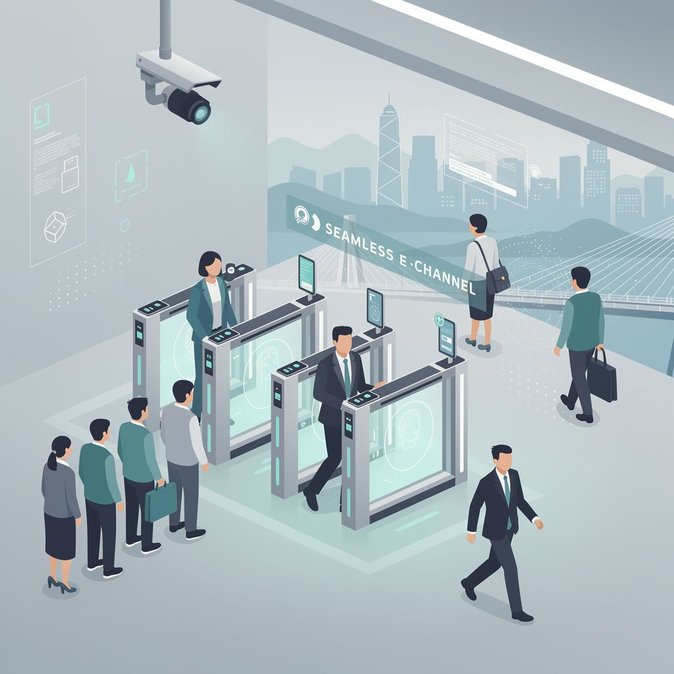
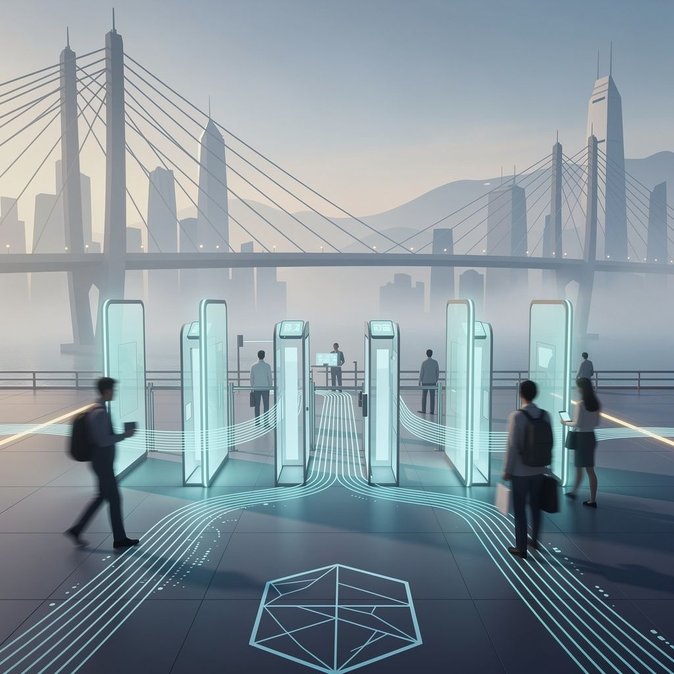
Hong Kong travellers crossing the Hong Kong-Zhuhai-Macao Bridge (HZMB) no longer have to break stride. At 6 a.m. on 25 June the Immigration Department switched on its first two “Seamless e-Channel” lanes at the HZMB Hong Kong Port. The new lanes pair overhead cameras, 3-D facial-recognition algorithms and AI-driven risk-profiling to identify a pre-registered traveller while he or she walks through the channel at normal speed, completing arrival or departure formalities in as little as five seconds. No documents, QR-codes or fingerprint scans are required. The pilot is open to Hong Kong permanent residents aged 11 or above who have crossed the bridge at least ten times in the past 90 days. About 50,000 frequent cross-border commuters meet that threshold, many of them entrepreneurs who shuttle between Hong Kong and manufacturing bases in the Greater Bay Area. Enrolment takes place at a dedicated counter inside the port building where officers capture a high-resolution facial image and verify travel history.
![Hong Kong rolls out “Seamless e-Channel” at Hong Kong-Zhuhai-Macao Bridge, slashing clearance time to 5 seconds]()
While registered travellers can breeze through immigration, many still need to manage visas for mainland China or other onward destinations. VisaHQ’s Hong Kong team (https://www.visahq.com/hong-kong/) helps by handling those applications end-to-end—submitting forms, arranging courier pickups and providing real-time tracking—so commuters can focus on business instead of paperwork.
Officials say the contact-free system reduces average clearance time from 30–45 seconds at a conventional automated gate to five seconds, boosting the port’s hourly handling capacity by roughly 40 per cent. That matters: weekday passenger throughput at the bridge has rebounded to around 80,000 since pandemic controls were lifted, and is expected to climb further as the “Southbound Cars” scheme expands in July. For business-travel managers the technology promises tighter itineraries and less queue anxiety, but there are caveats. Only travellers with a recent pattern of HZMB use can sign up during the pilot; visitors, residents who cross infrequently and elderly travellers who struggle with tech must still use traditional e-Channels or staffed counters. Privacy advocates are also watching closely: while the Immigration Department says bio-templates are encrypted and stored on-shore, Hong Kong’s new digital-search powers allow officers to demand device passwords, raising questions about proportionality. If the six-month pilot runs smoothly the government plans to retrofit up to 400 e-Channels city-wide, including Lo Wu, Lok Ma Chau and the airport. That would put Hong Kong in the same league as Dubai and Singapore, which already operate curb-to-gate biometric journeys. For now, frequent bridge users get an early taste of a friction-free future that could redefine how the region’s 90-million-strong Greater Bay Area commutes.
While registered travellers can breeze through immigration, many still need to manage visas for mainland China or other onward destinations. VisaHQ’s Hong Kong team (https://www.visahq.com/hong-kong/) helps by handling those applications end-to-end—submitting forms, arranging courier pickups and providing real-time tracking—so commuters can focus on business instead of paperwork.
Officials say the contact-free system reduces average clearance time from 30–45 seconds at a conventional automated gate to five seconds, boosting the port’s hourly handling capacity by roughly 40 per cent. That matters: weekday passenger throughput at the bridge has rebounded to around 80,000 since pandemic controls were lifted, and is expected to climb further as the “Southbound Cars” scheme expands in July. For business-travel managers the technology promises tighter itineraries and less queue anxiety, but there are caveats. Only travellers with a recent pattern of HZMB use can sign up during the pilot; visitors, residents who cross infrequently and elderly travellers who struggle with tech must still use traditional e-Channels or staffed counters. Privacy advocates are also watching closely: while the Immigration Department says bio-templates are encrypted and stored on-shore, Hong Kong’s new digital-search powers allow officers to demand device passwords, raising questions about proportionality. If the six-month pilot runs smoothly the government plans to retrofit up to 400 e-Channels city-wide, including Lo Wu, Lok Ma Chau and the airport. That would put Hong Kong in the same league as Dubai and Singapore, which already operate curb-to-gate biometric journeys. For now, frequent bridge users get an early taste of a friction-free future that could redefine how the region’s 90-million-strong Greater Bay Area commutes.