From 24 to 26 June, the International Centre for Migration Policy Development (ICMPD) convened ministers, EU officials and diaspora leaders in Gdańsk to map out how displaced Ukrainians can both support host economies and eventually contribute to rebuilding their homeland. The event, held under the banner “From Return to Participation”, featured EU Special Envoy Ylva Johansson, Poland’s Deputy Minister of Family and Social Policy Piotr Kwiecień and Ukraine’s Deputy Minister Ilona Havronska.
Amid such policy shifts, individuals and businesses alike may need expert guidance on navigating visas, residence permits and future status changes. VisaHQ’s Poland portal (https://www.visahq.com/poland/) offers up-to-date information, document checklists and end-to-end processing support, streamlining applications for Ukrainian nationals, their employers and other international partners who want to stay compliant as rules evolve.
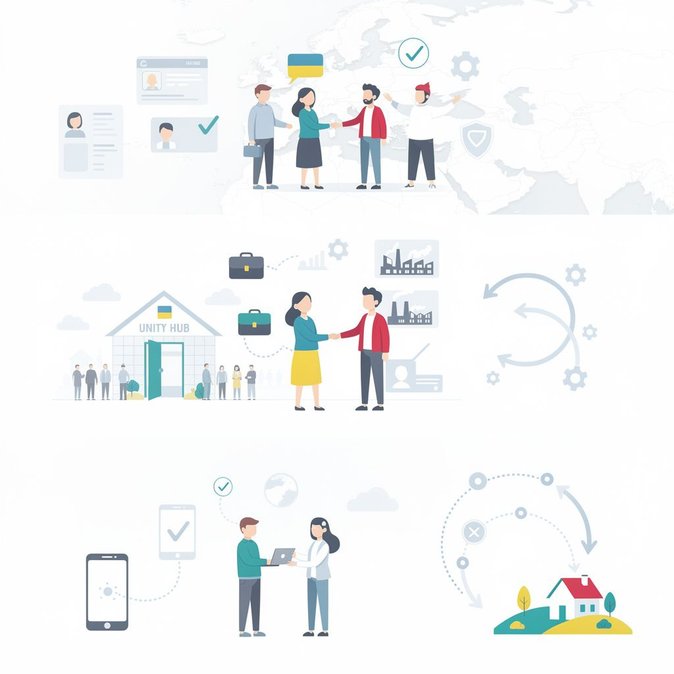
Panels showcased Poland’s rapid labour-market absorption of Ukrainians – 68 % employment according to ZUS data – and highlighted innovative “Unity Hubs” in Warsaw and Gdańsk that provide skills-matching, language courses and business-startup counselling. ICMPD unveiled a pilot Voluntary Return & Recovery Programme that offers micro-grants and job-placement assistance in Ukraine for those wishing to go back. For Polish employers the take-away is twofold: continued access to a motivated Ukrainian talent pool in sectors from IT to construction, and a likely tightening of retention as voluntary-return incentives scale up. HR departments should prepare succession plans and consider circular-mobility schemes that allow staff to work seasonally in Poland while contributing to reconstruction projects at home. The conference also called for EU funding to extend Poland’s MOS 2.0 digital residence system to manage eventual status conversions when temporary protection winds down. Observers expect formal proposals after the Commission’s new TPD extension clears the Council.
Amid such policy shifts, individuals and businesses alike may need expert guidance on navigating visas, residence permits and future status changes. VisaHQ’s Poland portal (https://www.visahq.com/poland/) offers up-to-date information, document checklists and end-to-end processing support, streamlining applications for Ukrainian nationals, their employers and other international partners who want to stay compliant as rules evolve.
Panels showcased Poland’s rapid labour-market absorption of Ukrainians – 68 % employment according to ZUS data – and highlighted innovative “Unity Hubs” in Warsaw and Gdańsk that provide skills-matching, language courses and business-startup counselling. ICMPD unveiled a pilot Voluntary Return & Recovery Programme that offers micro-grants and job-placement assistance in Ukraine for those wishing to go back. For Polish employers the take-away is twofold: continued access to a motivated Ukrainian talent pool in sectors from IT to construction, and a likely tightening of retention as voluntary-return incentives scale up. HR departments should prepare succession plans and consider circular-mobility schemes that allow staff to work seasonally in Poland while contributing to reconstruction projects at home. The conference also called for EU funding to extend Poland’s MOS 2.0 digital residence system to manage eventual status conversions when temporary protection winds down. Observers expect formal proposals after the Commission’s new TPD extension clears the Council.