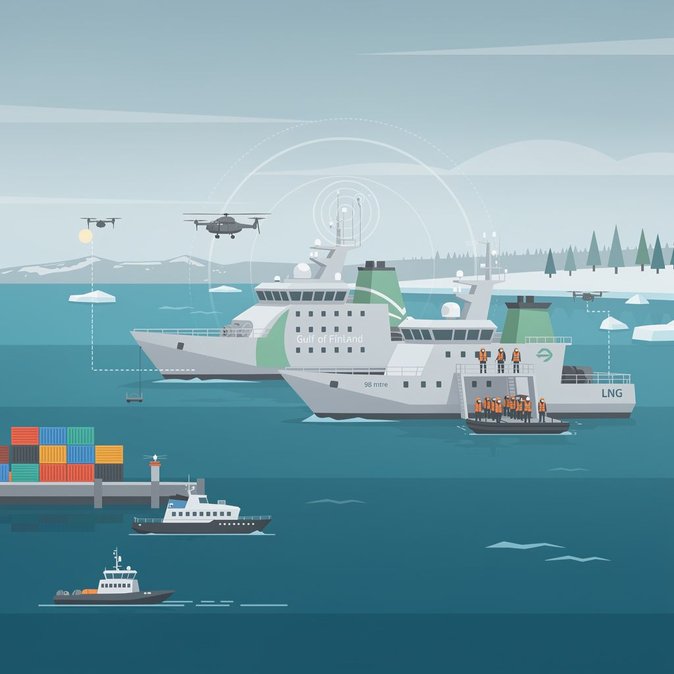
The Finnish Border Guard has confirmed that it will commission two new 98-metre offshore patrol vessels—Karhu and its yet-to-be-named sister ship—beginning this winter, with the second entering service in early 2027. Announced on 27 June 2026, the acquisition marks the most significant upgrade of Finland’s maritime border-control fleet in two decades and comes at a time of heightened geopolitical tension in the Baltic region. Each vessel is equipped with advanced radar, electro-optical sensors and a layered counter-drone suite capable of detecting, jamming and, if necessary, shooting down unmanned aerial vehicles. According to the Border Guard, the drones encountered near sea lanes and coastal critical infrastructure have tripled since 2024, prompting the government to allocate an additional €44 million in the 2026 supplementary budget for drone-defence capabilities. The vessels also feature a dedicated helicopter deck, room to evacuate up to 600 people and modular mission bays that can be reconfigured for search-and-rescue, environmental-protection or humanitarian tasks. For international shipping lines, cruise operators and offshore-energy companies that rely on the Gulf of Finland, the upgrade promises quicker incident response and improved surveillance of underwater traffic. Corporate mobility managers moving personnel or high-value cargo through Finnish ports can expect shorter security-related delays once the new assets are operational. In addition, the ships’ interoperability with Frontex-backed surveillance networks means real-time data can be shared with other Schengen states—important for businesses that operate multi-country logistics chains. Practically, travellers may notice an increased Border Guard presence at major ports such as Helsinki, Hanko and Kotka when the Karhu begins trial patrols later this year. The agency has indicated that routine vessel-boardings of pleasure craft will continue but should become more efficient thanks to the new on-board biometric and document-verification systems. Companies running charter vessels are advised to ensure crew lists and passenger manifests are submitted electronically in advance to avoid inspections that could eat into schedule buffers. Although the primary mission is security, officials stress the environmental upside: both ships run on dual-fuel LNG engines and are fitted with equipment for large-scale oil-spill response. For international firms that must meet ESG targets, partnering with Finnish maritime services is likely to carry lower reputational risk in the event of incidents. Overall, the investment underscores how technology-driven border control is becoming integral to Finland’s strategy of keeping its frontiers open to legitimate trade and travel while deterring hybrid threats.
Source: Kymenlaakso / EuropeSays