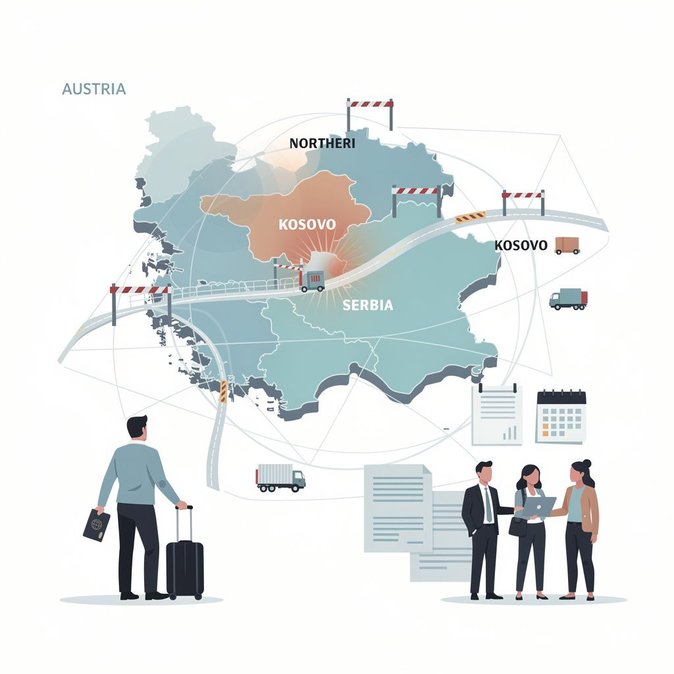
The Austrian Foreign Ministry (BMEIA) has published an updated travel advisory for Kosovo dated 29 June 2026. The advisory keeps the overall security classification unchanged but stresses that the situation in the four northern Serb-majority municipalities (Zubin Potok, Leposavić, Zvečan and North Mitrovica) remains tense and that non-essential travel to the area should be avoided. Austrian citizens and resident expatriates are urged to register their trips via the Foreign Ministry’s Auslandsservice-App and to follow local media and security-force instructions closely. Business travellers are reminded that impromptu demonstrations can lead to the temporary closure of individual border posts between Kosovo and Serbia, potentially disrupting regional supply chains and ground transport schedules. The ministry also draws attention to new entry rules that entered into force on 15 March 2026: Austrians (and all other Schengen travellers) may stay in Kosovo visa-free for “up to 90 days within any 180-day period.” The clarification removes earlier ambiguity around consecutive 90-day stays and brings Kosovo’s policy in line with Schengen practice. Travellers must still register their address with Kosovo Police within three days of arrival. Failure to do so can result in fines at exit, something that has caught out a number of visiting technicians and auditors in the past year. For trips that involve onward travel to Serbia, the ministry repeats a long-standing warning: Serbia does not recognise Kosovar entry stamps. Anyone crossing directly from Kosovo into Serbia without holding a prior Serbian entry stamp risks denial of entry or subsequent difficulties when trying to leave Serbia. Corporate mobility managers should therefore ensure that itineraries for staff and contractors avoid the direct Kosovo-Serbia land border unless the traveller first entered the region via Serbia. In practical terms, Austrian companies running projects in Pristina’s growing ICT and construction sectors should build extra buffer time into travel schedules, budget for potential detours via North Macedonia, and remind travelling staff that Austrian electronic ID cards (ID-Austria) are **not** recognised outside Austria. Passports or national ID cards must be carried. Use of the Foreign Ministry’s free online travel registration tool remains the most reliable way to receive push notifications of sudden border closures or security escalations. The advisory is a timely reminder that even within wider European business corridors, security conditions and documentary requirements can vary considerably. Firms with regional mobility programmes should review their standard operating procedures, especially for short-notice site visits and rotational assignments, to remain compliant and protect employees on the ground.