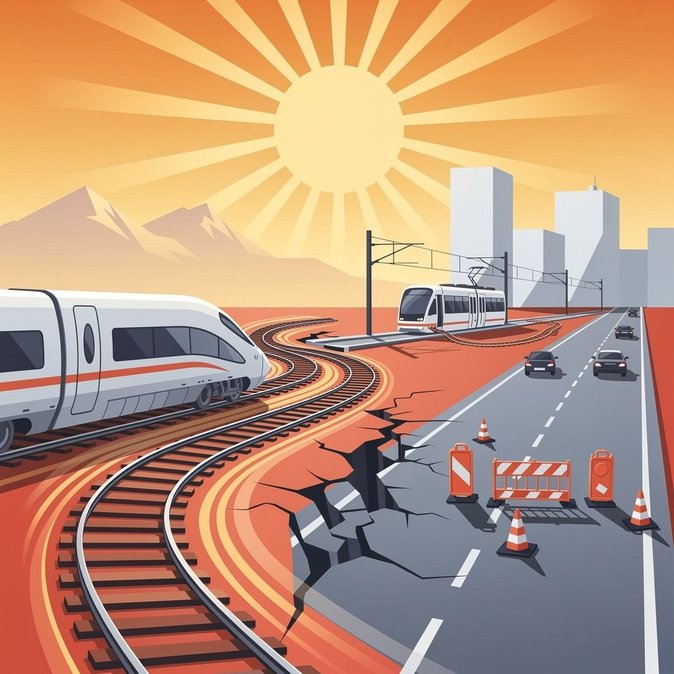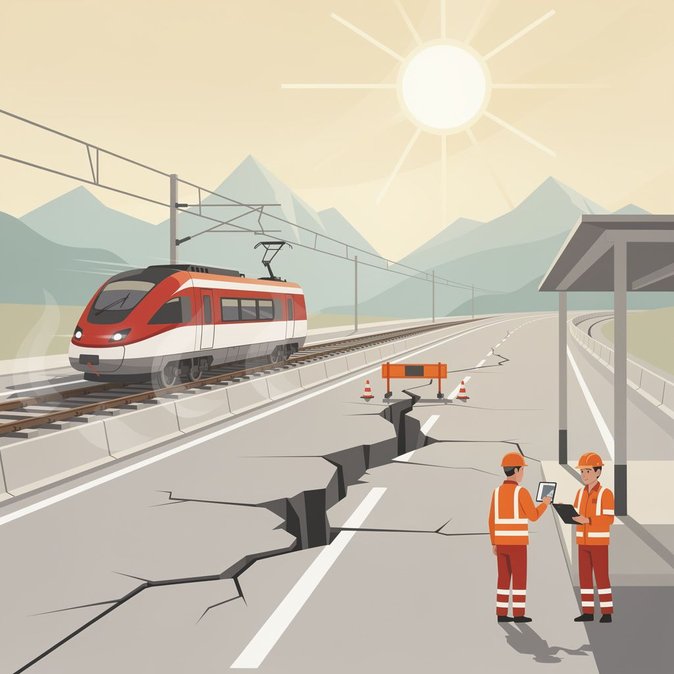
Austria’s hottest June on record is no longer just a climate statistic—it is an operational headache for every mode of transport. The mercury hit an unprecedented 40 °C in Vienna’s city centre on 28 June, and by Monday 29 June the knock-on effects were evident nationwide, The Local reports. ÖBB, the state rail operator, imposed emergency speed restrictions after thermal expansion caused track buckling near Hadersdorf am Kamp and in Tyrol’s Landeck district. Several long-distance services were diverted or slowed, extending Vienna–Innsbruck journey times by up to 70 minutes. Maintenance crews have been ordered onto round-the-clock shifts; however, specialists warn that welded rail lines can deform again once ambient temperatures exceed 38 °C. Roads fared little better. Austria’s motorway company ASFINAG confirmed concrete blow-ups on the A1 Westautobahn, forcing lane closures and 10-kilometre tailbacks. Asphalt softened on secondary routes, creating ruts that are especially dangerous for motorcycles. Drivers crossing the country received red alerts via the ÖAMTC traffic app, advising lower speeds and greater following distances. Beyond infrastructure, the heat is straining human performance. Freight forwarders told the Austrian Economic Chamber that lorry schedules are being re-sequenced to avoid midday loading, while Vienna Airport handed out free bottled water to ground-handling crews after several cases of heat exhaustion. Employers with posted workers are reminded that Austria’s Occupational Safety Code obliges them to provide shaded rest areas and adjust shift patterns during extreme heat alerts. Meteorologists expect a break later in the week, but climate scientists point out that such temperature spikes—once considered once-in-a-century events—are appearing every few years. Transport planners are therefore accelerating reviews of rail ballast specifications and experimenting with lighter-colour asphalt that reflects rather than absorbs heat. Whether funding keeps pace with physics remains to be seen.
Source: The Local Austria