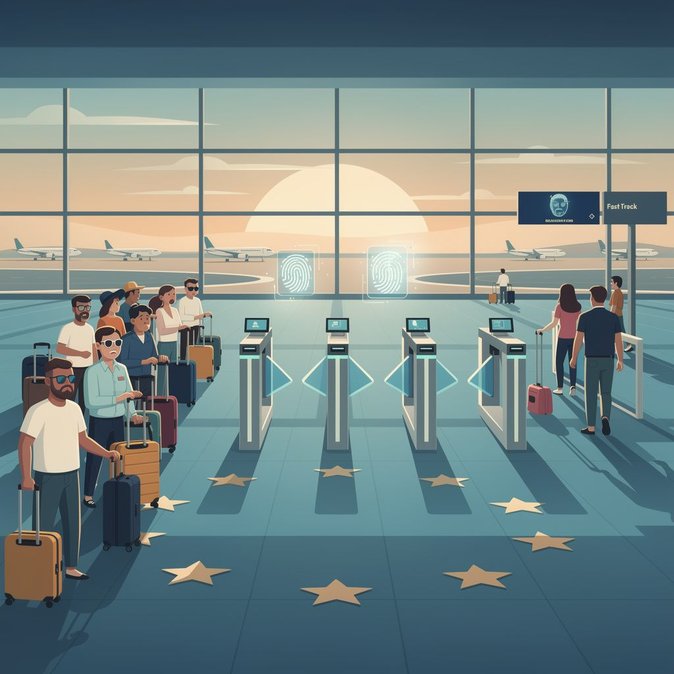
Europe’s three main aviation bodies – ACI Europe, Airlines for Europe (A4E) and IATA – published an open letter on 1 July warning that the Schengen Entry/Exit System (EES) has reached a “critical point”. Since becoming fully operational in April, the biometric regime has produced queues of up to five hours for non-EU passengers, with Madrid-Barajas and Barcelona-El Prat among the hardest-hit hubs.
For travellers and corporate travel managers looking for support, VisaHQ can provide up-to-the-minute guidance on Spain’s EES procedures and wider Schengen entry rules, as well as help organise any required visas or travel authorisations. Their dedicated Spain portal (https://www.visahq.com/spain/) offers quick eligibility checks, document checklists and optional concierge handling that can shorten preparation time before departure.
The industry groups are asking the European Commission to let Member States temporarily switch off EES whenever passenger volumes overwhelm border facilities, at least through August. They cite missed flight connections, stand congestion and mounting overtime costs for ground handlers. Smaller holiday airports serving Spain – such as Málaga, Alicante and Palma de Mallorca – are said to be particularly vulnerable because arrival halls lack space for overflow queues. For corporate mobility planners the implications are immediate: travellers from visa-exempt markets (US, UK, Canada, Australia, etc.) should build in longer connection buffers when routing through Spain this summer. Employers may also want to brief staff on biometric enrolment steps to speed passage. Some companies are exploring fast-track or VIP services as a stop-gap, although availability is limited. Spanish authorities privately support the call for flexibility but fear that suspending EES could jeopardise the planned launch of ETIAS in Q4 2026. The Commission has so far granted Member States only narrow derogations that allow agents to waive fingerprint capture in exceptional cases; airlines argue that is not enough to avert chronic congestion. Long-term, the letter raises the prospect that Spain – now one of Europe’s busiest tourist destinations – will need to invest further in e-gates, staffing and terminal redesign if it is to reconcile security goals with seamless travel.
For travellers and corporate travel managers looking for support, VisaHQ can provide up-to-the-minute guidance on Spain’s EES procedures and wider Schengen entry rules, as well as help organise any required visas or travel authorisations. Their dedicated Spain portal (https://www.visahq.com/spain/) offers quick eligibility checks, document checklists and optional concierge handling that can shorten preparation time before departure.
The industry groups are asking the European Commission to let Member States temporarily switch off EES whenever passenger volumes overwhelm border facilities, at least through August. They cite missed flight connections, stand congestion and mounting overtime costs for ground handlers. Smaller holiday airports serving Spain – such as Málaga, Alicante and Palma de Mallorca – are said to be particularly vulnerable because arrival halls lack space for overflow queues. For corporate mobility planners the implications are immediate: travellers from visa-exempt markets (US, UK, Canada, Australia, etc.) should build in longer connection buffers when routing through Spain this summer. Employers may also want to brief staff on biometric enrolment steps to speed passage. Some companies are exploring fast-track or VIP services as a stop-gap, although availability is limited. Spanish authorities privately support the call for flexibility but fear that suspending EES could jeopardise the planned launch of ETIAS in Q4 2026. The Commission has so far granted Member States only narrow derogations that allow agents to waive fingerprint capture in exceptional cases; airlines argue that is not enough to avert chronic congestion. Long-term, the letter raises the prospect that Spain – now one of Europe’s busiest tourist destinations – will need to invest further in e-gates, staffing and terminal redesign if it is to reconcile security goals with seamless travel.