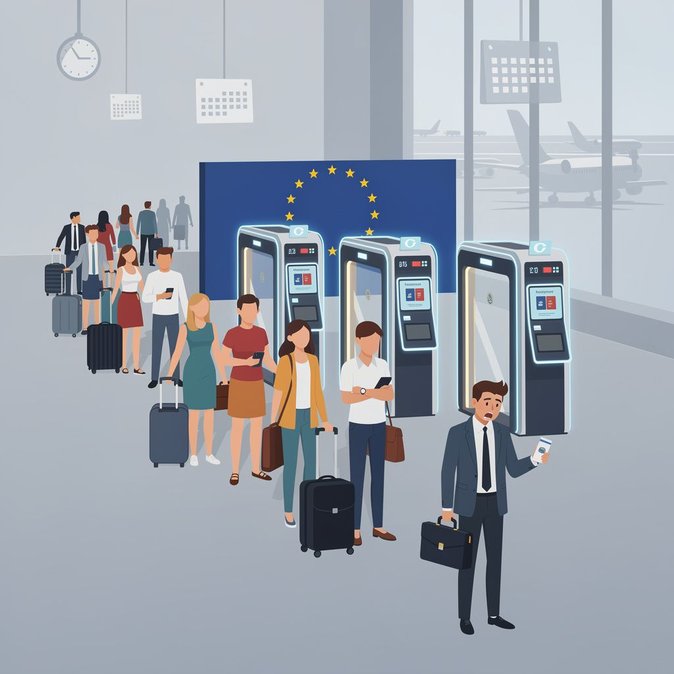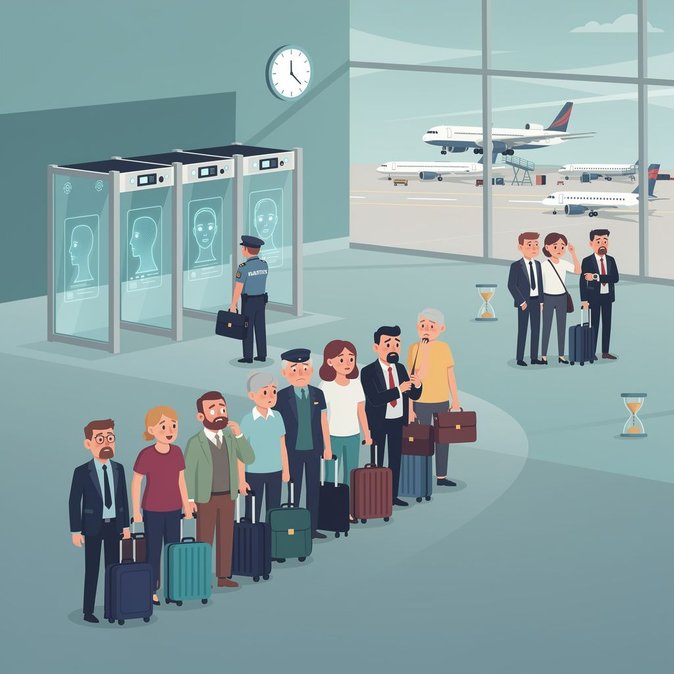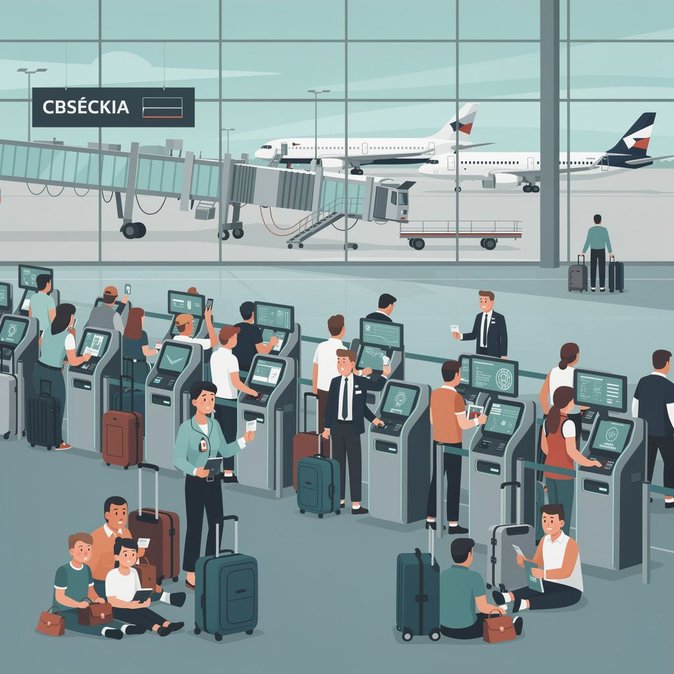
European airports, including Prague’s Václav Havel Airport, are warning that the EU’s recently-launched Entry/Exit System (EES) is buckling under midsummer passenger volumes. In an open letter sent on 1 July to Commission President Ursula von der Leyen, industry bodies ACI Europe, Airlines for Europe (A4E) and IATA say waiting times for non-EU travellers have reached “up to five hours”, forcing some flights to depart half-empty while passengers remain stuck in border-control lines. EES, fully operational since April 2026, replaces the passport-stamp routine with fingerprint and facial-image capture at every entry or exit from the Schengen Area. In practice, equipment failures and staffing shortfalls mean many stations can process only eight to ten travellers per minute instead of the planned 25, according to airport operations managers interviewed by Aviation Week. Prague airport officials told Czech media that peak-morning queues for flights to the UK and USA now stretch back to the duty-free zone, and they have opened a temporary hall in Terminal 1 to house additional kiosks. The industry wants Brussels to authorise Member States to “temporarily and completely” waive the biometric step whenever real-time demand exceeds capacity during July and August. In the past, Greece and France have already suspended EES checks for specific ports; the letter argues that a Europe-wide mechanism is needed to avoid chaotic, ad-hoc decisions that confuse travellers. Carriers fear that tour operators will reroute traffic to non-Schengen hubs such as Istanbul if the bottlenecks continue. For Czech companies moving staff in and out of the country, the risk is two-fold. First, business travellers from visa-waiver countries (USA, UK, Canada, Australia, Singapore) are most affected because they cannot enrol in advance; employers must now plan for an extra 60–90 minutes at arrival and departure. Second, missed onward connections will cascade into higher travel-insurance claims and duty-of-care costs. Mobility managers are advising travellers to book through-tickets with minimum three-hour layovers or, where possible, to enter the Schengen Zone via less-congested regional airports such as Brno-Tuřany. In the longer term, Czech border police say they will add 28 automated gates and hire 120 extra officers before the system’s next milestone on 10 July, when secondary biometric verification becomes mandatory for minors aged 12–17. Whether those measures will be enough remains unclear; the airline groups warn that without a summer derogation the EES “risks damaging Europe’s reputation for seamless travel at precisely the moment the region is trying to rebuild long-haul demand.”
Source: The Guardian