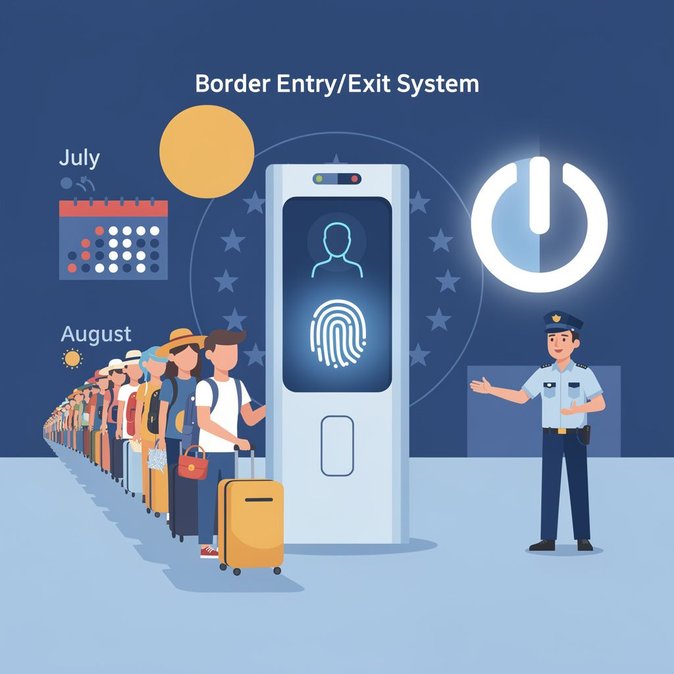
Barely 24 hours after Ryanair’s public broadside, a coalition of 20 major carriers and 28 airport operators—including Madrid-Barajas and Barcelona-El Prat—sent an open letter to European Commission President Ursula von der Leyen requesting an emergency ‘kill-switch’ for the Entry/Exit System (EES). Dated 1 July but released to media early on the 2nd, the document argues that member-state authorities should be empowered to deactivate biometric checks whenever passenger volumes exceed the design capacity of border facilities, at least until 31 August. Signatories claim live trials at Alicante and Palma last month produced average processing times of 110 seconds per traveller—far above the 45-second benchmark—implying queues of two hours or more once charter traffic peaks. They also cite concerns about data-protection compliance, pointing out that several Schengen-area police forces have yet to issue final privacy impact assessments. The letter’s timing is critical for Spain. On 3 July the Dirección General de Tráfico launches ‘Operación Verano’, which last year moved 104 million vehicles and 3.5 million North-Africa-bound passengers through Spanish territory. Any slowdown at air borders would ripple into the seaport and road network, officials warn. The Commission says states already possess “limited flexibility” under Article 14 of the EES Regulation to revert temporarily to manual stamping but must notify Brussels. Spain’s Interior Ministry is therefore drafting a contingency protocol that would allow on-the-spot suspension by senior Policía Nacional officers if waiting times consistently exceed 60 minutes. For companies relocating staff to Spain or rotating project teams through Schengen, the episode underscores the importance of registering biometrics on the first trip and retaining confirmation slips. Travel-risk policies should be updated to reflect potential overnight delays and to include accommodation caps at secondary airports.
Source: EuroEFE / Europa Press