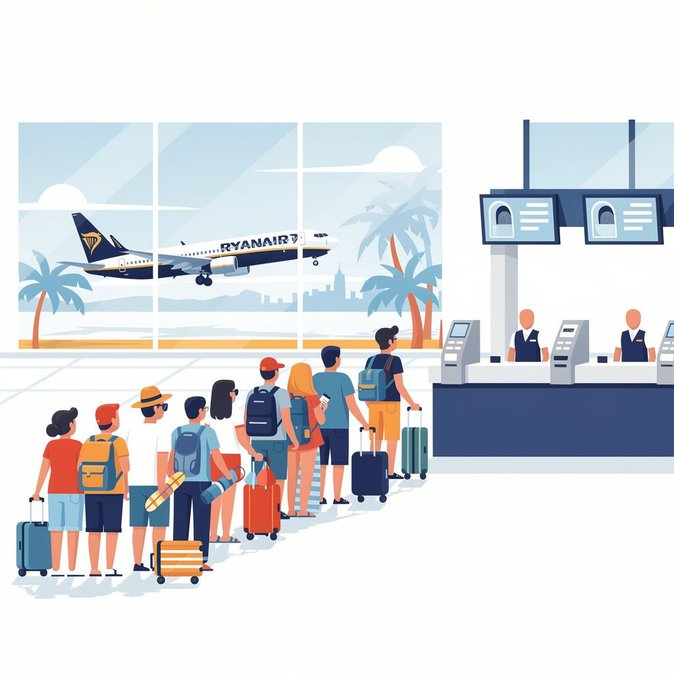
Low-cost carrier Ryanair has sounded the alarm over “unmanageable” waiting times it expects at several Spanish holiday gateways once the European Union’s new Entry/Exit System (EES) becomes fully operational on 10 July. In a sharply worded statement on 2 July, the airline said airports such as Tenerife South, Palma de Mallorca, Alicante-Elche and Málaga lack enough fingerprint kiosks and border-police booths to handle peak-season passenger flows.
The warning comes amid forecasts of more than 16 million international arrivals to Spain in July and August alone. EES replaces manual passport stamping for third-country nationals with a biometric database that captures fingerprints and facial images on first entry to the Schengen Area.
Industry lobby Airlines for Europe (A4E) and Airports Council International Europe back Ryanair’s call, urging Brussels to permit member states to suspend the system during July–August or risk hours-long queues and missed connections across the continent.
For Spain, the immediate risk is reputational and operational. Three of the four airports named by Ryanair rank among the country’s top ten tourist gateways; they collectively handled more than 75 million passengers in 2025.
Aena, the national airport operator, says it has installed 480 self-service kiosks nationwide but admits staffing remains “tight” during change-management training. The Interior Ministry has authorised overtime for 600 extra Policía Nacional officers, yet union representatives argue that at least double that number will be needed to guarantee 30-minute processing times.
Corporate travel managers should expect longer dwell times at outbound passport control for non-EU staff based in Spain.
For travellers seeking to stay ahead of the new rules, services like VisaHQ can shoulder much of the administrative burden. From clarifying Schengen entry requirements to pre-checking biometric documentation, the platform’s Spain portal (https://www.visahq.com/spain/) offers step-by-step guidance and live support that can reduce airport surprises and help corporates brief their employees before departure.
Advisories already recommend arriving three hours before departure at Madrid-Barajas and Barcelona-El Prat; regional airports with limited infrastructure could require even more buffer. Multinationals running summer meetings or incentive trips in Spain may wish to stagger group departures or book Fast-Track services where available.
Although the European Commission will meet airlines and airports next week to review contingency plans, officials insist the 10 July switch-on date remains “non-negotiable.” If no derogation is granted, Spanish airports could become a real-world stress test for the technology during the country’s busiest travel period in six years.
The warning comes amid forecasts of more than 16 million international arrivals to Spain in July and August alone. EES replaces manual passport stamping for third-country nationals with a biometric database that captures fingerprints and facial images on first entry to the Schengen Area.
Industry lobby Airlines for Europe (A4E) and Airports Council International Europe back Ryanair’s call, urging Brussels to permit member states to suspend the system during July–August or risk hours-long queues and missed connections across the continent.
For Spain, the immediate risk is reputational and operational. Three of the four airports named by Ryanair rank among the country’s top ten tourist gateways; they collectively handled more than 75 million passengers in 2025.
Aena, the national airport operator, says it has installed 480 self-service kiosks nationwide but admits staffing remains “tight” during change-management training. The Interior Ministry has authorised overtime for 600 extra Policía Nacional officers, yet union representatives argue that at least double that number will be needed to guarantee 30-minute processing times.
Corporate travel managers should expect longer dwell times at outbound passport control for non-EU staff based in Spain.
For travellers seeking to stay ahead of the new rules, services like VisaHQ can shoulder much of the administrative burden. From clarifying Schengen entry requirements to pre-checking biometric documentation, the platform’s Spain portal (https://www.visahq.com/spain/) offers step-by-step guidance and live support that can reduce airport surprises and help corporates brief their employees before departure.
Advisories already recommend arriving three hours before departure at Madrid-Barajas and Barcelona-El Prat; regional airports with limited infrastructure could require even more buffer. Multinationals running summer meetings or incentive trips in Spain may wish to stagger group departures or book Fast-Track services where available.
Although the European Commission will meet airlines and airports next week to review contingency plans, officials insist the 10 July switch-on date remains “non-negotiable.” If no derogation is granted, Spanish airports could become a real-world stress test for the technology during the country’s busiest travel period in six years.