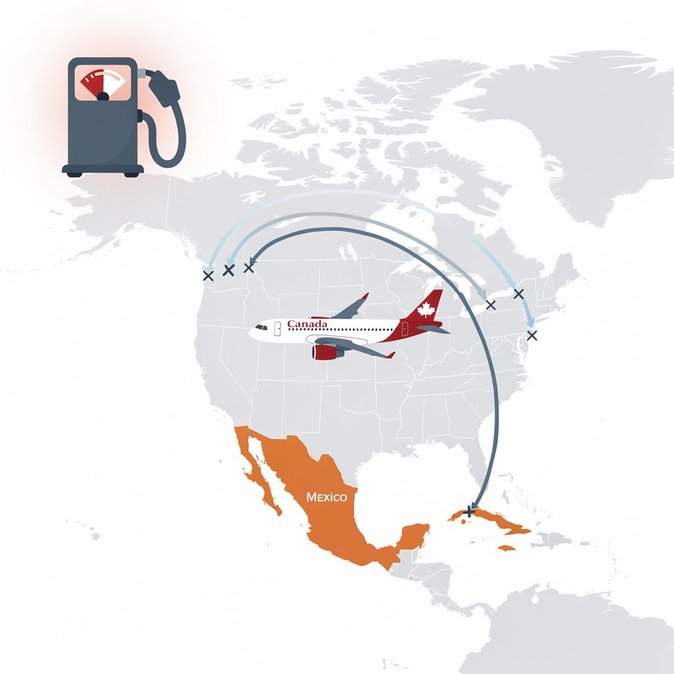
Air Canada announced further reductions to its U.S. network on July 6, cancelling or delaying eight transborder routes for the upcoming winter season. Three Midwest routes from Toronto and Montreal are scrapped for a second consecutive winter, while seasonal services to Florida from Ottawa, Montreal and Quebec City will now start in December instead of October. The carrier will also continue its suspension of Toronto and Montreal flights to New York-JFK. The airline says the changes align capacity with demand as jet-fuel prices remain elevated amid geopolitical instability in the Middle East.
Amid this shuffle of routes and schedules, travellers suddenly rerouted through new cities—or pivoting to alternative destinations such as Mexico—may find themselves juggling fresh entry requirements. VisaHQ can smooth that process: the company’s online portal lets Canadian passengers quickly secure or amend U.S., Mexican and other visas, offers real-time application tracking and provides expert support to keep itineraries on track. Full details are available at https://www.visahq.com/canada/
Statistics Canada data show Canadian air arrivals from the U.S. fell 28 percent year-over-year through May, underscoring soft leisure demand despite a strong Canadian dollar. Air Canada plans to redirect assets to higher-yield markets, adding up to five daily flights between Toronto’s Billy Bishop Airport and New York-LaGuardia this winter and boosting frequencies to Mexico, part of a strategy to grow Latin American capacity 18 percent next summer. Competitors WestJet and Air Transat have already trimmed U.S. flying, raising concerns for corporate travellers reliant on nonstop links to secondary American cities. Travel managers are advised to rebook itineraries early, as Bilateral Open Skies rules allow U.S. carriers to backfill only some of the lost capacity. Clients with ongoing NAFTA/CUSMA business commitments should monitor schedule updates and consider remote-work alternatives to avoid visa-appointment rescheduling triggered by itinerary changes.
Amid this shuffle of routes and schedules, travellers suddenly rerouted through new cities—or pivoting to alternative destinations such as Mexico—may find themselves juggling fresh entry requirements. VisaHQ can smooth that process: the company’s online portal lets Canadian passengers quickly secure or amend U.S., Mexican and other visas, offers real-time application tracking and provides expert support to keep itineraries on track. Full details are available at https://www.visahq.com/canada/
Statistics Canada data show Canadian air arrivals from the U.S. fell 28 percent year-over-year through May, underscoring soft leisure demand despite a strong Canadian dollar. Air Canada plans to redirect assets to higher-yield markets, adding up to five daily flights between Toronto’s Billy Bishop Airport and New York-LaGuardia this winter and boosting frequencies to Mexico, part of a strategy to grow Latin American capacity 18 percent next summer. Competitors WestJet and Air Transat have already trimmed U.S. flying, raising concerns for corporate travellers reliant on nonstop links to secondary American cities. Travel managers are advised to rebook itineraries early, as Bilateral Open Skies rules allow U.S. carriers to backfill only some of the lost capacity. Clients with ongoing NAFTA/CUSMA business commitments should monitor schedule updates and consider remote-work alternatives to avoid visa-appointment rescheduling triggered by itinerary changes.