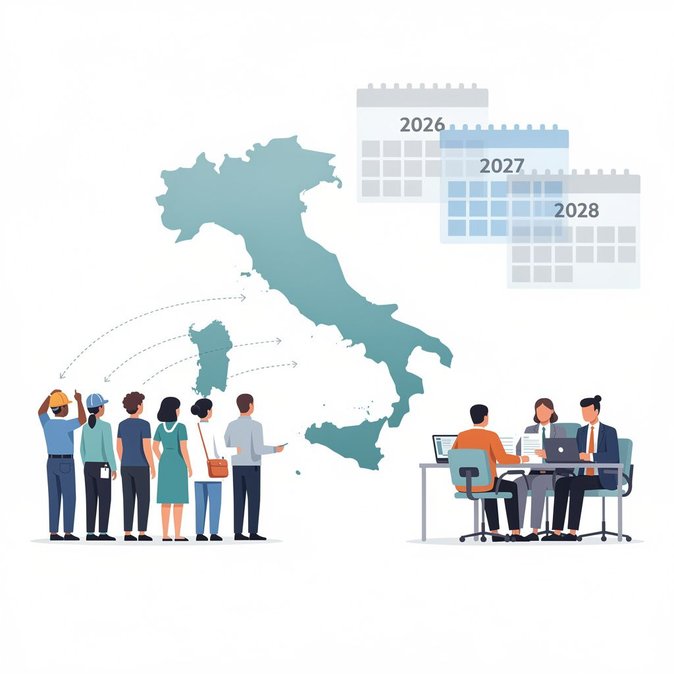
After months of drafting, the Meloni Cabinet is poised to adopt the long-awaited 2026-2028 ‘decreto flussi’, setting an historic ceiling of 500,000 entry slots for non-EU workers over three years—up from 450,000 in the previous cycle. A revised draft seen by La Sicilia and updated on 7 July allocates 164,850 permits for 2026, with similar numbers for 2027-28, split between non-seasonal employees, the care sector and seasonal agriculture.
At this stage, many firms will benefit from specialist support: VisaHQ, for example, offers tailored assistance with Italy’s work-visa procedures, helping employers assemble compliant sponsorship files, schedule timely submissions and track outcomes across multiple prefectures. Their dedicated Italy portal details service packages for decreto-flussi applications as well as other immigration categories.
Notably, 76,850 places per year are earmarked for highly-qualified and non-seasonal roles, reflecting employer lobbies’ calls to widen the talent pipeline in construction, logistics and digital services ahead of Italy’s 2026-30 National Recovery Plan. The decree also introduces “incentive quotas” reserved for nationals of countries that conduct anti-smuggling media campaigns in partnership with Italy—a carrot designed to encourage cooperation on irregular migration deterrence. For HR departments the headline is the timetable: pre-compilation on the ministry portal is expected to open in early September, with click-days staggered by sector to avoid the 2024 server crashes. Companies are urged to prepare sponsorship dossiers now, including proof of accommodation and compliance with new salary-threshold rules aligned with collective agreements. Immigration lawyers caution that conversion of quotas into actual permits has historically lagged; only 7.8 % of 2024 slots turned into residence cards within 12 months. Streamlining at prefecture level and digital fingerprints on-site are promised but yet to be tested.
At this stage, many firms will benefit from specialist support: VisaHQ, for example, offers tailored assistance with Italy’s work-visa procedures, helping employers assemble compliant sponsorship files, schedule timely submissions and track outcomes across multiple prefectures. Their dedicated Italy portal details service packages for decreto-flussi applications as well as other immigration categories.
Notably, 76,850 places per year are earmarked for highly-qualified and non-seasonal roles, reflecting employer lobbies’ calls to widen the talent pipeline in construction, logistics and digital services ahead of Italy’s 2026-30 National Recovery Plan. The decree also introduces “incentive quotas” reserved for nationals of countries that conduct anti-smuggling media campaigns in partnership with Italy—a carrot designed to encourage cooperation on irregular migration deterrence. For HR departments the headline is the timetable: pre-compilation on the ministry portal is expected to open in early September, with click-days staggered by sector to avoid the 2024 server crashes. Companies are urged to prepare sponsorship dossiers now, including proof of accommodation and compliance with new salary-threshold rules aligned with collective agreements. Immigration lawyers caution that conversion of quotas into actual permits has historically lagged; only 7.8 % of 2024 slots turned into residence cards within 12 months. Streamlining at prefecture level and digital fingerprints on-site are promised but yet to be tested.