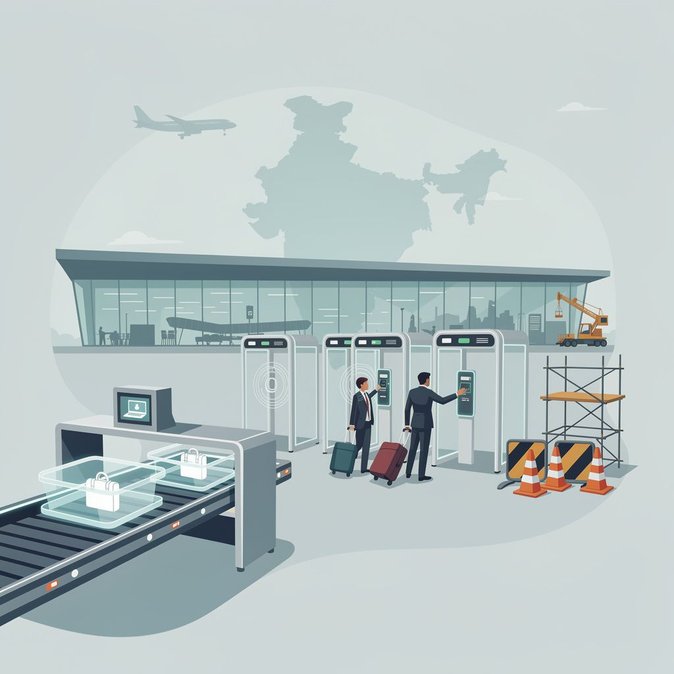
Following several months of passenger congestion at Mumbai, Delhi and Bengaluru airports, the Centre has approved a sweeping package of technology upgrades intended to speed every stage of the traveller journey. At a review held late on 8 July 2026, Home Minister Amit Shah and Civil Aviation Minister Ram Mohan Naidu directed agencies to deploy Automatic Tray Retrieval Systems (ATRS) at security, expand e-gates, and roll out a nationwide Fast Track Immigration-Trusted Traveller Programme (FTI-TTP) awareness drive. Under the plan, 21 airports now under construction will incorporate ATRS and biometric e-gates by design, while 41 existing airports will receive retrofits based on traffic volume.
For travellers who still need to arrange visas, extensions or OCI documentation ahead of these infrastructure rollouts, VisaHQ offers a streamlined alternative to consulate visits. The company’s portal walks applicants through every requirement, provides real-time status updates and can coordinate directly with FRRO offices—making it easier to pair compliant paperwork with the government’s new fast-track airport experience.
The Bureau of Civil Aviation Security will set mandatory aerobridge-to-passenger ratios to reduce bus-boarding bottlenecks, and baggage-drop counters—currently limited to 16 international airports—will be extended to tier-2 locations. On the immigration side, officials confirmed that FRRO offices will be opened in every state headquarters within the next two years, giving foreign nationals local access to registration and visa extension services. Airlines have been asked to push WhatsApp messages inviting passengers to pre-enrol in FTI-TTP, which slashes clearance time at e-gates from three minutes to thirty seconds. For mobility managers, the upgrades mean reassessing travel-time assumptions and advising executives to sign up for FTI-TTP early. Technology suppliers, meanwhile, will see tenders for ATRS lanes, biometric kiosks and e-gate maintenance contracts. The move also complements the new digital e-OCI card, paving the way for OCI holders to use fast-track e-gates without carrying physical documents. Implementation will be phased but rapid—airport operators have been told to submit blueprints within 60 days, with quarterly progress reviews chaired by the Home Secretary. Industry bodies welcome the initiative, noting that Delhi’s Terminal 3 already piloted ATRS with a 24 % increase in passenger throughput.
For travellers who still need to arrange visas, extensions or OCI documentation ahead of these infrastructure rollouts, VisaHQ offers a streamlined alternative to consulate visits. The company’s portal walks applicants through every requirement, provides real-time status updates and can coordinate directly with FRRO offices—making it easier to pair compliant paperwork with the government’s new fast-track airport experience.
The Bureau of Civil Aviation Security will set mandatory aerobridge-to-passenger ratios to reduce bus-boarding bottlenecks, and baggage-drop counters—currently limited to 16 international airports—will be extended to tier-2 locations. On the immigration side, officials confirmed that FRRO offices will be opened in every state headquarters within the next two years, giving foreign nationals local access to registration and visa extension services. Airlines have been asked to push WhatsApp messages inviting passengers to pre-enrol in FTI-TTP, which slashes clearance time at e-gates from three minutes to thirty seconds. For mobility managers, the upgrades mean reassessing travel-time assumptions and advising executives to sign up for FTI-TTP early. Technology suppliers, meanwhile, will see tenders for ATRS lanes, biometric kiosks and e-gate maintenance contracts. The move also complements the new digital e-OCI card, paving the way for OCI holders to use fast-track e-gates without carrying physical documents. Implementation will be phased but rapid—airport operators have been told to submit blueprints within 60 days, with quarterly progress reviews chaired by the Home Secretary. Industry bodies welcome the initiative, noting that Delhi’s Terminal 3 already piloted ATRS with a 24 % increase in passenger throughput.