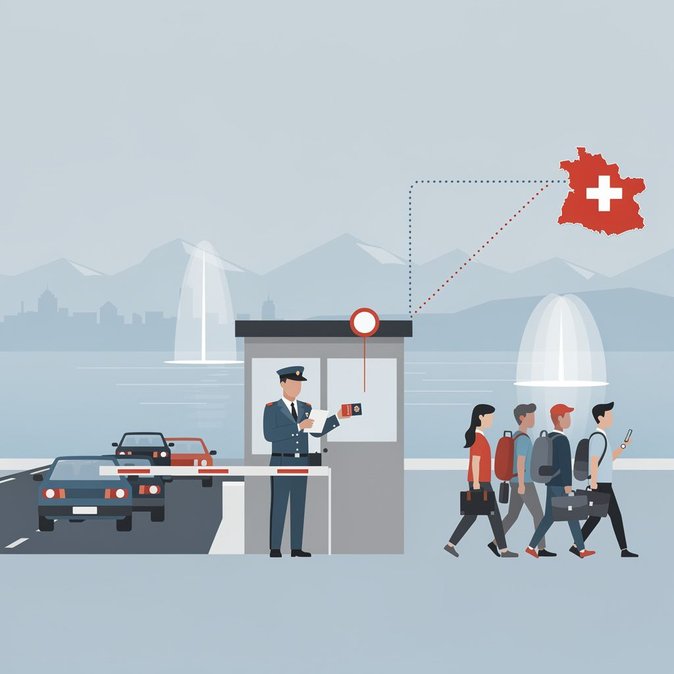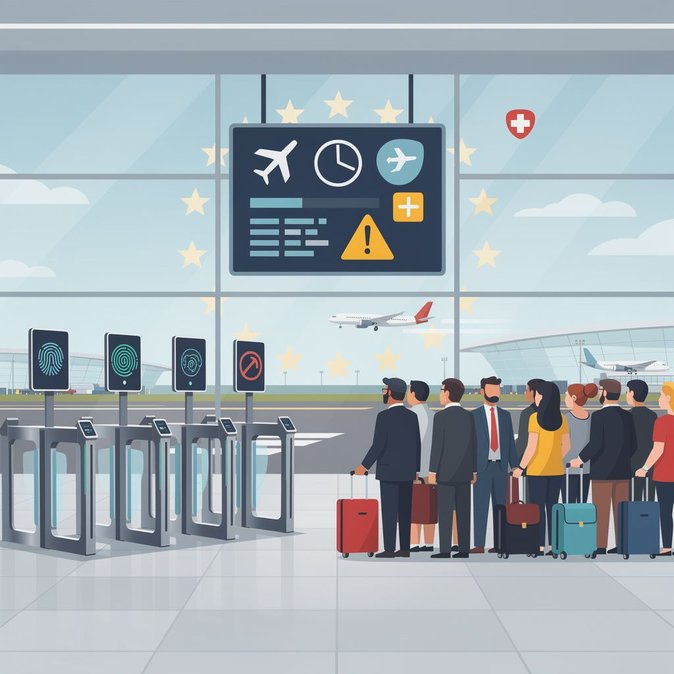
Switzerland has joined eight other Schengen-associated states in formally requesting the European Commission to allow temporary suspensions of the bloc’s new Entry/Exit System (EES) at airports during periods of exceptional passenger volumes. In a letter sent this week, Bern argues that the biometric border-control platform, which became mandatory across the Schengen Area on 10 April 2026, risks overwhelming airport infrastructure at the height of the summer season. The State Secretariat for Migration (SEM) told the Keystone-SDA news agency that a uniform, pan-European approach is needed so that individual countries are not forced to improvise unilateral solutions. The EES replaces manual passport stamping with automatic recording of travellers’ fingerprints and facial images, generating a single database of entries and exits for all non-EU nationals. While the system is considered a cornerstone of the EU’s new “smart borders” architecture, early operational tests in Geneva and Zurich revealed longer queues at transfer security and tighter minimum-connection times. Airport operators fear that peak-day passenger flows—forecast at more than 200,000 movements across Switzerland’s three international hubs in late July—could trigger bottlenecks that spill over into air-traffic delays and missed connections. Switzerland’s request is echoed by Germany, France, Italy and Spain, all of which are grappling with similar capacity constraints. Industry bodies such as Airlines for Europe (A4E) and the European Regions Airline Association have backed the call, warning that without calibrated roll-out measures companies will face higher disruption costs and travellers could experience a sharp deterioration in the reliability of short-haul business itineraries. If Brussels grants the waiver, Swiss border guards would be allowed to revert temporarily to the previous manual-stamping procedure, giving airports flexibility to divert passengers to staffed booths when e-gates reach saturation. Travel-management companies advise corporate clients to build in longer connection windows and to monitor real-time wait-time dashboards being piloted at Geneva and Zurich. The Commission is expected to respond before the end of July. Even if a derogation is approved, it is likely to be limited in time and scope; Switzerland would still be obliged to complete full EES registration for all first-time entrants. For global mobility teams, the episode is a reminder that technological upgrades to Europe’s border architecture continue to involve transitional growing pains—particularly for countries like Switzerland that sit at the crossroads of intra-European and intercontinental travel.
Source: SWI swissinfo.ch