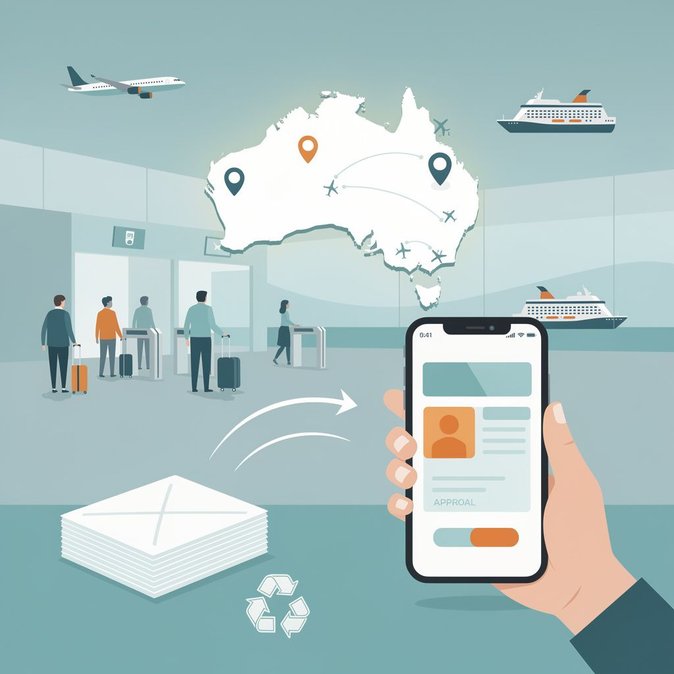
Australia is finally consigning the orange-and-white Incoming Passenger Card to history. In a joint announcement on 13 July 2026, four federal ministers confirmed that the Australian Border Force (ABF) will extend the Australia Travel Declaration (ATD) to every international airport and seaport over the next 18 months. The ATD began as an in-app pilot on select Qantas flights in late 2024, allowing passengers to answer bio-security and immigration questions up to 72 hours before departure. More than 450,000 travellers have already used it, with Qantas reporting average arrivals processing times falling by ten minutes. The Albanese Government has allocated A$56.1 million to scale the system. The money funds a web-form version of the ATD, further trials of contact-less arrivals gates and work on co-locating some domestic and international operations to cope with passenger growth expected in the lead-up to the 2032 Brisbane Olympics. According to ABF Commissioner Gavan Reynolds, the digital card will allow officials to “update questions at the click of a button” when new bio-security threats emerge, and will give risk-assessment teams better data before travellers even land. For business-travel managers the shift is significant. Pre-population of traveller profiles should speed up group movements and reduce errors that now lead to on-arrival delays. Companies will also gain earlier visibility of staff who forget to declare food, plants or equipment, limiting corporate penalties. Immigration lawyers say the ATD will dovetail with the Department of Home Affairs’ planned Digital Passenger Verification (DPV) platform, eventually integrating visa grant notices, vaccination records and even airline boarding passes. Airports are bracing for an operational shake-up. Brisbane and Melbourne will add dedicated ATD help-desks this quarter, while Perth and Adelaide will migrate to the system by year-end. Cruise terminals in Sydney and Fremantle are earmarked for phase-two rollout by mid-2027, a move welcomed by the cruise sector that still relies on manual clearance of thousands of arriving passengers. In the longer term, Canberra wants the ATD to become a two-way channel: outbound Australians would lodge customs and export declarations through the same app, mirroring Singapore’s SG Arrival Card. Industry groups argue that the investment is overdue—paper cards were introduced in 1965 and cost airlines an estimated A$8 million a year in printing and handling—but warn that digital exclusion and language support must be addressed before the paper form disappears for good.