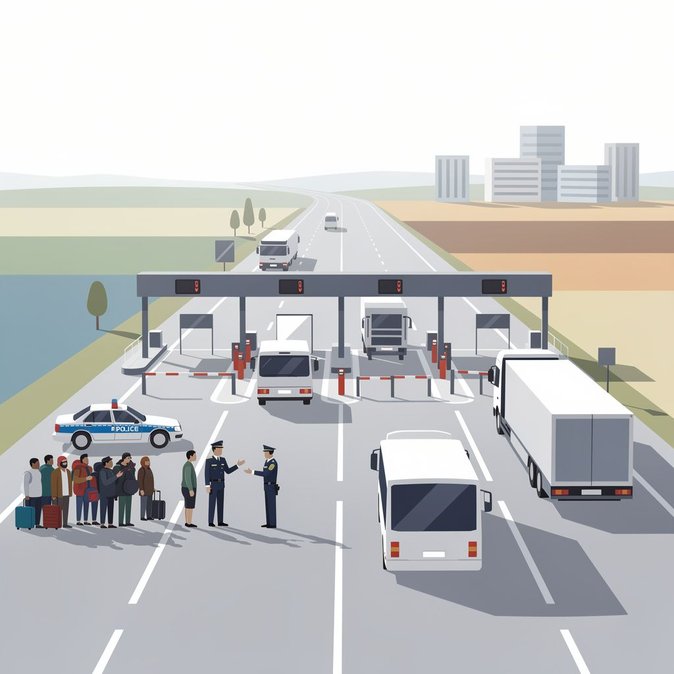
Germany’s Federal Police announced on 13 July 2026 that only 439 people were apprehended for unauthorised entry at the Polish-Mecklenburg-Vorpommern land border in the first half of 2026—a 46 percent fall from 813 in the same period in 2025. According to the Bad Bramstedt regional directorate, the steepest decline was recorded in June, the first full month after Berlin prolonged temporary controls on its frontiers with Poland, the Czech Republic and Switzerland. The controls were re-introduced in July 2025 to curb secondary migration via the so-called “Belarus route”, whereby non-EU nationals are flown to Minsk and pushed towards the EU’s eastern external border. Under the regime, travellers entering Germany by road or rail from Poland must be prepared for on-the-spot passport checks, vehicle inspections and, in some cases, biometric enrolment. 389 of the 439 migrants detected in 2026 were immediately returned to Polish territory under bilateral readmission arrangements, and 94 outstanding arrest warrants were executed during the checks. For Polish businesses that rely on same-day cross-border deliveries and commuter traffic to Germany, the figures are encouraging. A lower interception rate eases congestion at major crossings such as Świecko/Frankfurt-Oder and Gubin/Guben, reducing transit times for lorries and buses. Nevertheless, freight forwarders still report cost increases of 3-5 percent due to the unpredictability of random stops and the need for drivers to carry additional documentation. Warsaw, which has maintained its own internal Schengen controls on the Lithuanian and German borders until at least 1 October 2026, welcomed the German statistics as proof that coordinated enforcement is working. Human-rights NGOs, however, warn that the apparent success may simply reflect tighter upstream policing rather than a real decrease in demand for irregular routes and have called for faster, safer legal pathways for seasonal and low-skilled workers. Looking ahead, logistics companies on both sides expect the controls to stay in place through the autumn harvest season, when migration pressures traditionally rise. Multinationals with Polish facilities are therefore advising travelling staff to budget an extra 30–45 minutes for road crossings and to ensure that national ID cards or passports remain valid for at least three months, even for routine day trips.
Source: DPA via Die Zeit