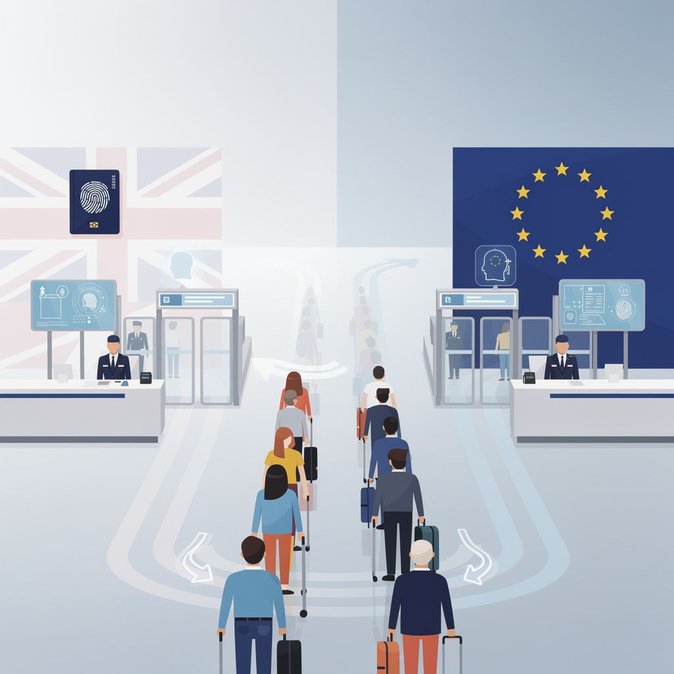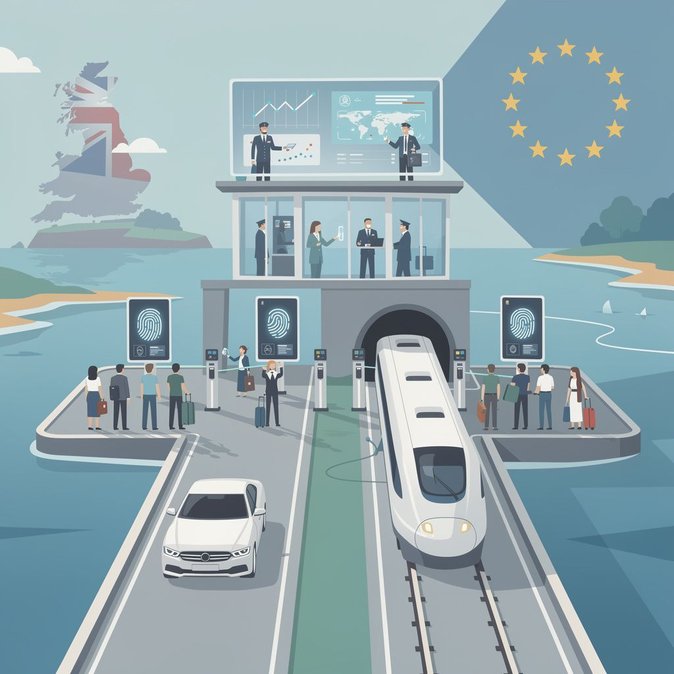
The UK government has moved to head off a new source of holiday-season disruption by opening a direct line with Brussels over implementation of the EU’s Entry/Exit System (EES). In a call late on 13 July, Transport Secretary Heidi Alexander secured agreement from the European Commissioner for Sustainable Transport, Apostolos Tzitzikostas, to coordinate the roll-out of biometric exit and re-entry checks that will apply to all non-EU nationals—including British citizens—crossing the Schengen border from 6 October. Under the EES, travellers must have their passport scanned and their face and fingerprints captured the first time they cross into the Schengen zone after go-live. While most of that processing will take place in French or other EU frontier posts, a portion of first-time enrolments will happen at juxtaposed controls in Dover, at Eurostar terminals and at Eurotunnel’s Folkestone site. Concerns have been rising among carriers that the extra steps could create summer-style tailbacks every weekend. To avert that, the Department for Transport has now committed a further £20 million—on top of £10.5 million already spent—to add passport booths, segregate coach traffic and improve traffic-flow technology in Kent. Industry leaders welcomed the cash and the new EU dialogue. Doug Bannister, CEO of the Port of Dover, said the port was “really grateful for the Secretary of State’s personal involvement,” adding that Dover will increase border booth capacity by 40 % before October. Eurostar confirmed it is testing mobile enrolment kiosks that could register frequent travellers before they reach the station. The French Interior Ministry has also agreed in principle to open a joint operations room during the first month of EES implementation to monitor queue data in real time. For corporates the message is to plan ahead. Business-travel policies should allow an extra 45 minutes for first outbound crossings after 6 October, especially for employees who have not visited the EU since October 2025, when early-adopter pilots began. HR teams are also being advised to brief staff that EES registration is separate from ETIAS—the €7 travel authorisation that will not start until mid-2027—so there is no payment or online form to complete in advance. Companies running weekend trade-show stands are urged to ship exhibition material mid-week rather than rely on Friday evening channel crossings. Although the government insists that “summer 2026 travel will be protected,” carriers are lobbying for a grace period during which repeat British passengers can be waved through if booths are saturated. The Commission has so far resisted, but the new UK-EU working group will revisit the idea in August. If no derogation is secured, many travel managers expect to stagger essential travel in the first fortnight of October to avoid the worst queues.
Source: Department for Transport (UK)