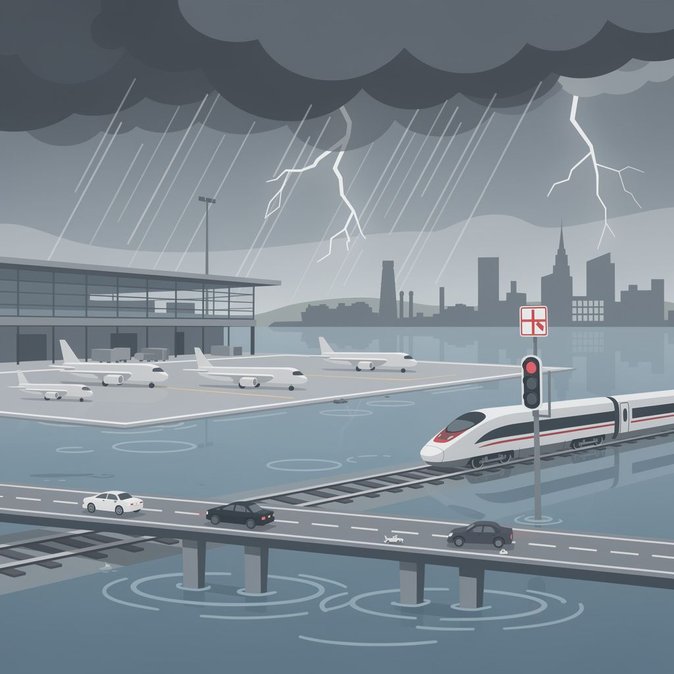
A line of violent thunderstorms swept across southern Germany on the evening of 15 July, dumping up to 90 mm of rain in under three hours and forcing transport operators to suspend services. Munich Airport diverted 37 flights and cancelled a further 62, while Stuttgart and Memmingen closed their aprons temporarily for lightning safety. Deutsche Bahn halted long-distance ICE services between Munich and Ulm after mudslides blocked tracks near Günzburg. The German Weather Service (DWD) issued its highest-level warning (“Stufe 4”) for the districts of Rosenheim, Garmisch-Partenkirchen and the Allgäu. Flash floods inundated parts of the A96 and B17, causing overnight gridlock that spilled into the morning commuter window. Business travellers headed to client sites in the automotive and life-science clusters around Munich were among those stranded. Insurers estimate property damage at €120 million, but for corporate mobility teams the bigger impact was operational: several multinational firms had to postpone plant audits and shift meetings online. Lufthansa deployed larger Airbus A350 aircraft on intra-European routes on 16 July to clear the passenger backlog, and Deutsche Bahn activated its disaster timetable, honouring tickets irrespective of reservation. Experts point out that climate-driven thunderstorm cells are becoming more frequent; travellers should therefore build weather contingency clauses into German itineraries, including flexible hotel bookings and alternative rail or car-rental options. Local authorities say clean-up operations could last until the weekend, with residual delays likely on the Munich–Augsburg ICE corridor and at Stuttgart Airport’s security checkpoints, where staffing was stretched by overnight roster changes.
Source: Anadolu Agency