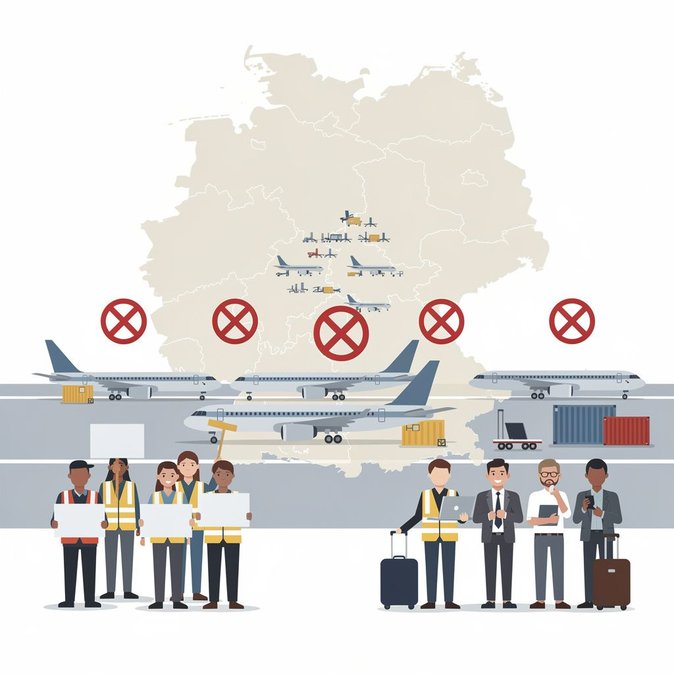
Germany’s busiest airports are bracing for a day-long shutdown after the public-sector union Verdi called a warning strike for ground-handling and security staff from 00:01 on Monday, 20 July 2026. The walk-out will hit Frankfurt, Munich, Berlin-Brandenburg, Hamburg, Düsseldorf, Cologne/Bonn, Hannover, Bremen, Dortmund and Leipzig/Halle, affecting an estimated 150,000 passengers and roughly 2,000 scheduled departures and arrivals. Fraport, the operator of Frankfurt Airport, has already urged travellers to stay away from the terminals and warned that no outbound services will operate during the stoppage. Berlin-Brandenburg (BER) issued a similar notice saying passenger operations will “come to a complete standstill”. The strike is part of a broader pay dispute covering 2.5 million federal and municipal employees. Verdi is demanding an 8 % wage increase, higher shift bonuses and three additional days of annual leave, arguing that inflation and a chronic labour shortage have eroded real incomes. Employers have so far refused to match those demands, citing tight municipal budgets. Two earlier rounds of talks ended without agreement and a fourth round is scheduled for next week. Business-travel managers are scrambling to re-route essential trips via foreign hubs such as Amsterdam and Zurich or to move meetings online. Lufthansa and its subsidiaries have activated their “irregular operations” (IROPS) teams and will offer no-cost rebooking on rail services where possible. Freight forwarders fear cascading effects on belly-hold cargo, particularly for automotive and pharmaceutical supply chains that rely on Germany’s hub-and-spoke network. The strike also underscores growing labour unrest at German transport providers. Since January, airport security, rail conductors, local transport drivers and even federal police officers at land borders have staged intermittent industrial action, often with minimal notice. Corporate mobility departments are therefore expanding contingency plans, including larger ticket inventories on alternative carriers and advance booking of meeting rooms to switch to virtual formats at short notice. For globally mobile staff, the key takeaway is to monitor flight status continuously, build additional lead time into itineraries and keep re-booking rules at hand. EU Regulation 261 compensation will only apply if airlines fail to notify passengers at least 14 days in advance – something carriers insist they cannot do when strikes are announced on short notice. Travellers holding critical visas that are date-sensitive (e.g., German ICT or Fiktionsbescheinigung re-entry windows) should document any missed appointments carefully for later extension requests.
Source: Berlin Today