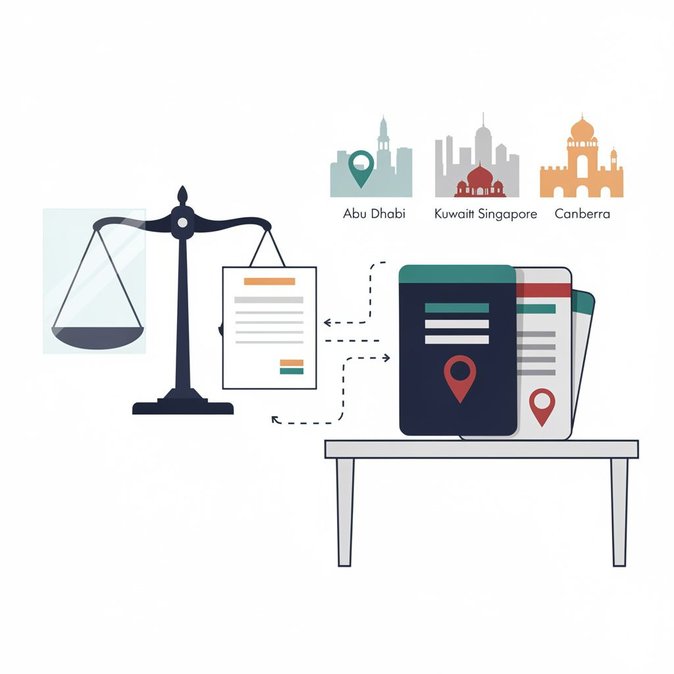
The Supreme Court of India on 20 July 2026 dismissed the Union government’s special-leave petitions challenging a 15 July Delhi High Court judgment that had quashed the Ministry of External Affairs’ (MEA) ₹2,000-crore tender for outsourcing Consular, Passport and Visa (CPV) services at four large Indian missions—Abu Dhabi, Kuwait, Singapore and Canberra. A three-judge Bench headed by Chief Justice Surya Kant agreed with the High Court that the technical evaluation process was opaque and arbitrary, violating the principles of transparency required in public procurement. While refusing to revive the tender, the Court recognised the critical public-service nature of visa and passport processing and therefore allowed the MEA and its implementing agency Engineers India Ltd (EIL) to put short-term stop-gap arrangements in place. Existing service providers may be retained or a suitable interim agency appointed, but only until a fresh Request for Proposal (RFP) is completed—something the Court directed the government to finish “preferably within three months.” The verdict settles an eight-month legal battle triggered by losing bidders E Trav Tech and Verasys, who alleged that identical proposals were scored differently across missions and that bid-opening sequences were manipulated. It also highlights the strategic importance of India’s 130-plus outsourced visa centres worldwide, which process more than 15 million applications annually for businesses, tourists, students and expatriate Indians. Corporate mobility managers should prepare for transitional turbulence at the four affected posts. Until new vendors are selected, travellers may face longer processing times and reduced customer-service windows, particularly for fast-track and in-person services such as police-clearance certificates and surrender certificates. Companies with large travelling workforces are advised to monitor mission notices, build in additional lead time, and explore filing in neighbouring jurisdictions where permissible under MEA rules. The case may prompt the MEA to overhaul its entire outsourcing policy, introduce clearer scoring matrices, and expand digital self-service channels—changes that, if implemented well, could ultimately shorten queues and improve the applicant experience worldwide.
Source: LiveLaw / Asianet Newsable