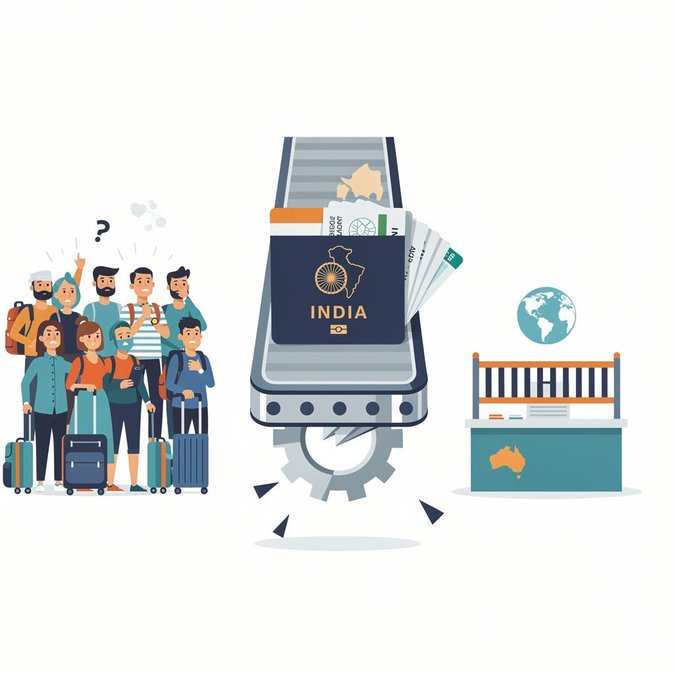
Australian residents seeking Indian passports, visas or police-clearance certificates have been left in limbo after VFS Global, India’s long-standing outsourcing partner, halted new applications from 1 July 2026. The suspension follows the Delhi High Court’s cancellation of the MEA’s multi-mission outsourcing tender and the subsequent expiry of VFS contracts for Australia, Kuwait and the UAE. Bloomberg and The Economic Times report that thousands of applicants have been unable to file paperwork in Sydney, Melbourne, Perth and Brisbane. Some, facing urgent travel or immigration deadlines, have opted to fly to India to complete formalities in person—turning what is normally a two-hour centre visit into a multi-day international trip with significant cost. Corporate mobility teams say delayed police clearances are already jeopardising Australian permanent-residency invitations that expire after 60 days. Until the MEA finalises a new vendor—an exercise that could take three months or more—only emergency walk-in services are being entertained at the Indian High Commission in Canberra. Even those are limited to life-and-death situations, leaving routine business-traveller and student-visa applicants stuck. Companies planning to mobilise Indian talent into Australia, or to send Australian nationals to India on short-term work assignments, should factor in at least four extra weeks for paperwork and consider alternate sequencing of project start dates. The episode underscores the operational risk inherent in single-vendor models for large expatriate markets. Experts argue that India may need to license multiple service providers in major countries—mirroring the UK’s approach—to ensure redundancy and competition. In the meantime, mobility managers are advised to track mission advisories daily, maintain digital scans of all employee documents to expedite submission once services resume, and, where feasible, lodge electronic Visa-on-Arrival or e-Visa requests for certain categories that remain unaffected. Longer term, the disruption could accelerate India’s shift toward fully digital consular platforms, reducing dependence on physical outsourcing centres and creating a more resilient ecosystem for the country’s booming global diaspora.