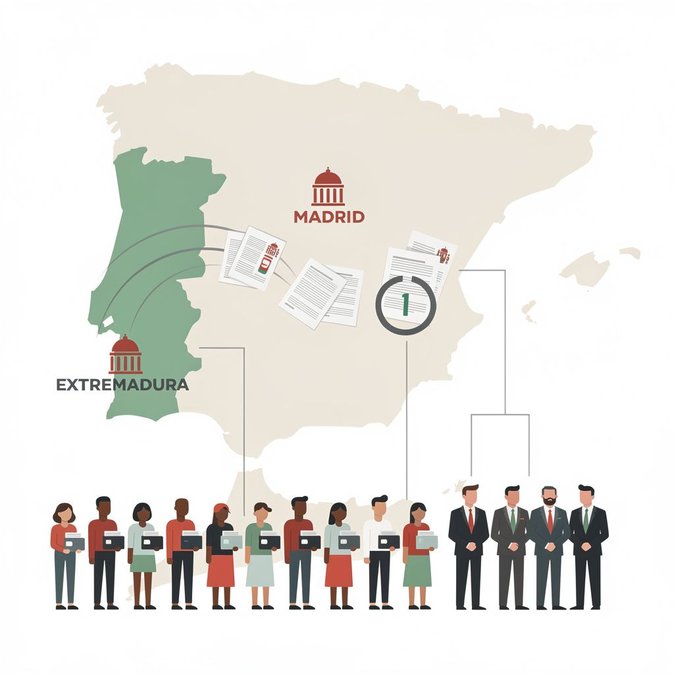
The government of Extremadura has formally requested detailed documentation from Madrid on the legal, economic and social impact of Spain’s extraordinary migrant regularisation scheme that closed to new applications on 30 June. In a letter sent late on 22 July to the Ministry of Inclusion, Security and Migration, the regional executive asks for the complete Memoria del Análisis de Impacto Normativo (MAIN) plus every opinion, technical report and inter-ministerial note that was used to justify Royal Decree 316/2026, the legal basis of the amnesty. Regional officials argue that without access to the central government’s modelling they cannot calculate future spending on health, education and social services or design labour-market programmes for the almost 10,000 applicants who filed in Extremadura. The request also presses Madrid to clarify its stance at the 4 May EU summit in Armenia, where Spain voted against a 33-nation pact to share real-time migration data and jointly monitor smuggling networks. Extremadura says that decision could raise compliance costs for the regions if Brussels tightens border-management rules in 2027. Behind the procedural language is a wider political dispute. Extremadura’s coalition, which includes the anti-immigration party Vox, claims the regularisation plan was rushed through and may shift unfunded obligations onto Spain’s autonomous communities. National officials counter that the decree merely brings into the formal economy workers already resident in Spain and will expand the Social Security base; they stress that the state will cover healthcare for the first year after approval. For mobility managers and multinational employers the row matters because the timeline for issuing work authorisations could lengthen if regions delay processing. Companies planning to hire newly regularised staff should verify whether local extranjería offices anticipate back-logs or additional documentary requirements. HR teams are also advised to track the September deadline for applicants to correct files; missing a regional notice could push a case into 2027. At this stage no court challenge has been filed, but Extremadura’s demand signals that other regions governed by the conservative PP–Vox bloc may follow suit. Any coordinated action could force Madrid to reopen parts of the decree or negotiate cost-sharing mechanisms—moves that would inject fresh uncertainty into Spain’s flagship inclusion project.
Source: Región Digital