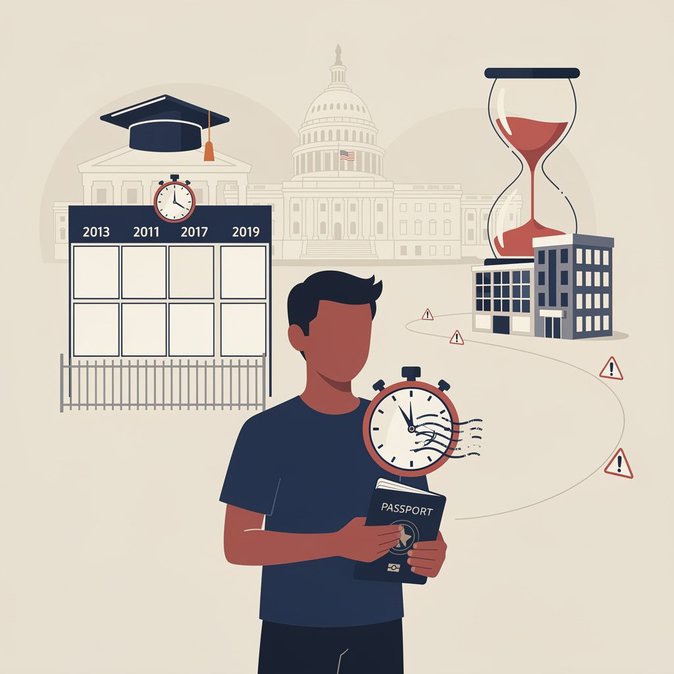
The Department of Homeland Security’s long-anticipated final rule replacing the open-ended "duration of status" (D/S) admission with a fixed end-date was published on 17 July and dominated campus briefings when universities reopened from the holiday break on 22 July 2026. Beginning 15 September 2026, most F-1 students, J-1 exchange visitors, and their dependents will receive an "Admit-Until-Date" (AUD) tied to their program end date, not to exceed four years—after which they must depart the United States or file a Form I-539 extension with U.S. Citizenship and Immigration Services (USCIS). Key changes include a 30-day grace period for F-1 students (down from 60 days), mandatory USCIS extensions for program changes, and a 24-month ceiling on English-language study. Graduate students will no longer be free to change majors mid-program, and undergraduate transfers are limited to post-first-year moves absent case-by-case approval. Violations of the new time limits will trigger automatic accrual of unlawful presence, reviving a penalty that can bar re-entry for up to ten years. For multinational employers that recruit heavily from U.S. universities, the rule complicates internship pipelines and training rotations. Students who need more than four years to finish dual degrees or Ph.D. research must now secure government approval instead of a simple Designated School Official (DSO) notation. That adds cost, uncertainty, and potentially months of processing time—particularly problematic if the student plans to transition to Optional Practical Training (OPT) or an H-1B cap-gap period. Universities are scrambling to update compliance systems. Auburn University, the University of Maryland Baltimore County, and the New Jersey Office of the Secretary of Higher Education each issued campus-wide alerts on 22 July warning that proactive academic planning is now essential. Advisers are urging students to map out degree timetables and, where possible, accelerate coursework to avoid extension filings that could jeopardize international travel or post-graduation employment. Litigation is widely expected; higher-education associations argue the rule will deter global talent and overburden both USCIS and institutions. DHS has signaled that implementation could slip by up to two years if courts intervene, but schools and employers can’t wait. Companies relying on CPT, OPT, or J-1 academic training should audit their pipelines now, budget for extension fees, and consider contingent staffing models if key graduates face delayed work authorization under the new time-bound system.