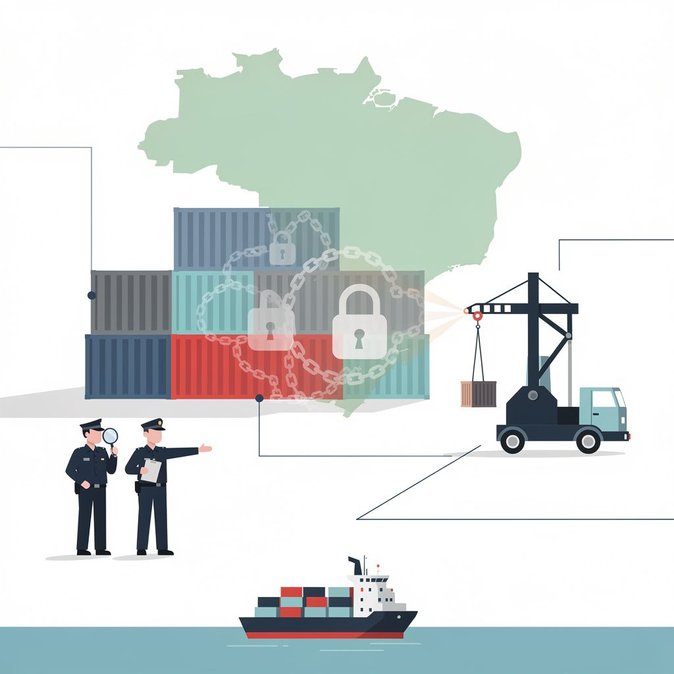
Brazil’s Federal Police (PF) dealt a major blow to transnational organised crime on Thursday, 23 July 2026, with Operation “Commodity”, a coordinated raid across four states that targeted a logistics ring accused of shipping at least 6.5 tonnes of cocaine to European ports since 2021. The investigation revealed sophisticated smuggling techniques that exploited Brazil’s booming agricultural export routes—masking drug bricks in coffee, cement and even chemically altered construction materials loaded into maritime containers. Thirteen preventive arrest warrants and 44 search-and-seizure orders were executed in São Paulo, Minas Gerais, Santa Catarina and Espírito Santo. Nine suspects are already in custody, and courts have frozen assets valued at up to R$ 1 billion, including luxury real estate and cryptocurrency holdings allegedly used to launder profits. One suspect was fatally wounded after opening fire on officers in Igaratá, SP. The probe, supported by the multi-agency Task Force FICCO, uncovered links to criminal cells in Bolivia and the Netherlands, underscoring Brazil’s role as both origin and gateway for narcotics bound for Europe and, increasingly, Asia. From a global-mobility perspective, the operation highlights the enforcement environment awaiting freight forwarders, maritime-services companies and supply-chain managers operating in Brazil’s ports. Customs authorities are expected to intensify scanning and risk-profiling of outbound containers from Santos, Paranaguá and Itajaí—terminals frequently cited in the PF dossier. While legitimate exporters welcome tighter controls, trade consultants warn of short-term delays and potential demurrage costs, particularly for agricultural commodities shipped in break-bulk seasons. The crack-down also dovetails with Brazil’s wider push to secure entry into the OECD and deepen trade agreements such as the mooted Mercosur-EU deal. Demonstrating robust anti-narcotics enforcement is a core benchmark in Brussels and Washington, which have signalled that port-security standards will factor into market-access concessions. Companies relocating expatriate staff to manage Brazilian export operations should reassess personal-security protocols around port zones and ensure compliance teams are up-to-date on red-flag indicators for trade-based money-laundering schemes. Legal analysts note that new asset-forfeiture tools introduced in the 2025 Anti-Crime Package allowed prosecutors to freeze cryptocurrency wallets within hours—a first in a PF narcotics case. Cross-border mobility specialists therefore expect enhanced background checks on foreign executives joining Brazilian logistics firms, as banks and insurers broaden know-your-customer (KYC) questionnaires to cover exposure to sanctioned entities.
Source: Polícia Federal (Brazil)