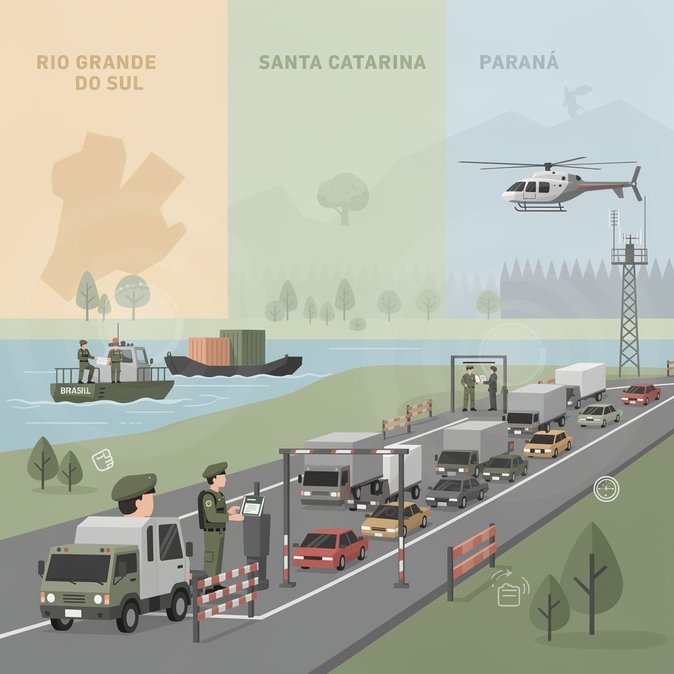
Brazil’s Armed Forces launched Operation Ágata Arco Sul-Sudeste 2026 this week, intensifying patrols along the land borders of Rio Grande do Sul, Santa Catarina and Paraná. Although the campaign officially began on 20 July, its large-scale deployment was first visible to travellers on 24 July, with roadblocks on BR-285 and river patrols near the Uruguay River. Co-ordinated by the Joint Command “Tamandataí,” the operation brings together the Army, Navy, Air Force, Federal Police, Receita Federal and state military police forces, supported by environmental agencies such as IBAMA and ICMBio. Mobile checkpoints are inspecting personal documentation, cargo manifests and vehicle chassis numbers to curb narcotics, weapons and wildlife smuggling. For cross-border business traffic—including trucking of auto parts from Argentina and soy shipments to Uruguay—the major immediate impact is slower transit times. Carriers report waits of up to two hours at key crossings such as São Borja–Paso de los Libres. Companies with just-in-time supply chains are being urged by logistics associations to build in 24- to 48-hour buffers until the end of the exercise on 5 August. Historically, Ágata waves have yielded spikes in customs seizures but also caused flight and bus delays as airports in the region increase random passenger screening. Mobility managers with assignees in Porto Alegre or Curitiba should brief staff on potential spot-checks and carry originals (or notarised copies) of passports, work permits and vehicle rental contracts. The Ministry of Defence says the programme supports the government’s new Integrated Border-Protection Plan (PPIF 2.0), due to roll out nationally in 2027. Corporations engaged in cross-border e-commerce should expect more frequent synchronised operations and invest in compliance training for drivers and customs brokers.
Source: Rádio Fronteira