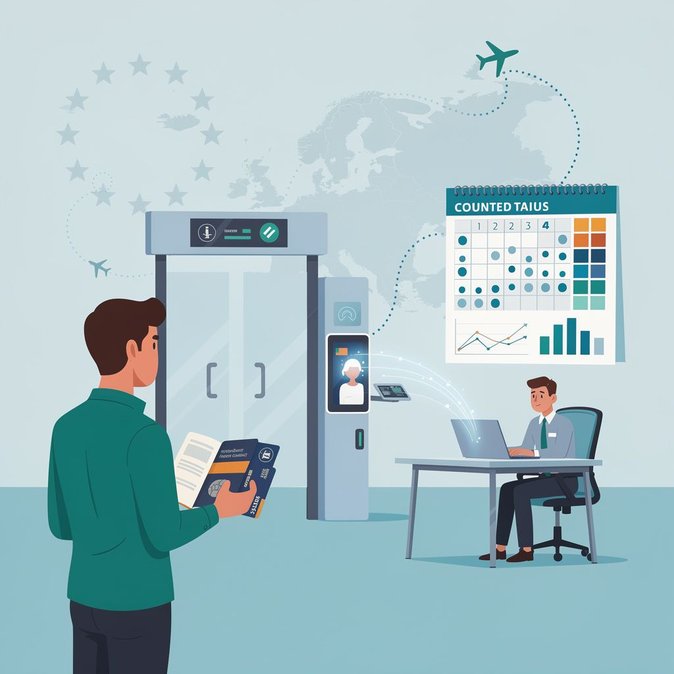
The European Commission’s Directorate-General for Migration and Home Affairs yesterday (27 July 2026) published new guidance clarifying which travellers are exempt from the EU’s recently-launched Entry/Exit System (EES). The EES, which went live across all external Schengen borders on 10 April 2026, automatically registers the passport, fingerprints and facial image of non-EU short-stay visitors and calculates their authorised length of stay. In its first three-and-a-half months the system has logged more than 145 million border crossings. The note is particularly relevant for organisations moving staff between Ireland and continental Europe. While EU citizens and those travelling on long-stay visas issued by Schengen states are exempt from biometric capture, the Commission confirms that holders of Irish residence permits or long-stay “D” visas are **not** exempt and **will continue to be registered in the EES when crossing into the Schengen Area**. This means an Indian national on an Irish Critical Skills Employment Permit flying from Dublin to Paris will still have fingerprints and a facial scan taken on arrival, even though they already hold an Irish residence card. Companies must therefore allow extra processing time at the first Schengen border point and ensure that staff understand the procedure. For business travellers the main practical implication is compliance with the 90/180-day Schengen rule. Because the EES will automatically calculate overstays, Irish-based multinationals must closely track days spent inside Schengen—not just trips that originate in Ireland but also connecting itineraries via the UK or other third countries—to avoid fines or future entry bans. Human-resources teams should update travel calendars and brief employees on the difference between Irish immigration permission (which applies only in Ireland) and Schengen short-stay entitlements. The guidance also lists other exempt categories—such as Andorran and Vatican passport holders and family members of EU citizens with residence cards—but stresses that these travellers must still present proof of their status at the border. Irish companies hosting guests from these categories should ensure that invitation letters and residence documentation are carried to avoid delays. Overall, the Commission’s clarification removes lingering ambiguity about Irish documentation in the new system and underlines the importance of robust travel-tracking policies for any organisation with a mobile workforce based in Ireland.