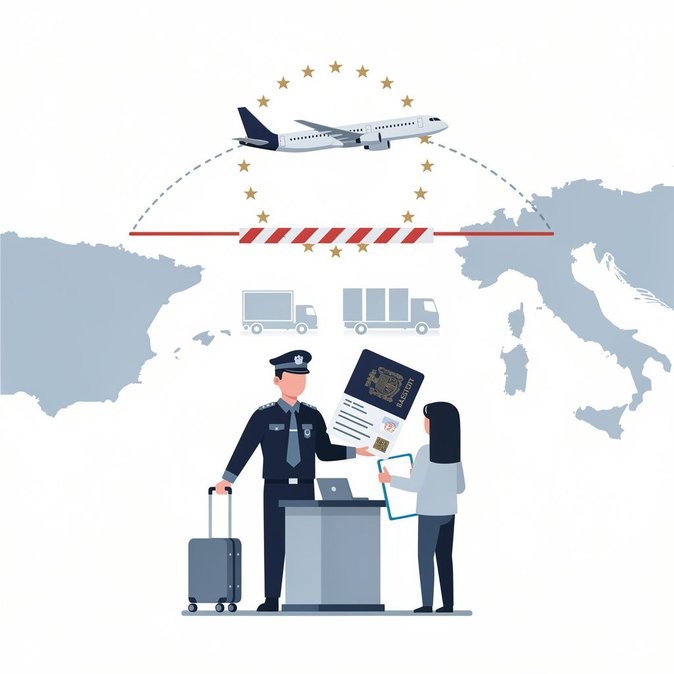
Italy’s Prime Minister Giorgia Meloni signalled on 30 July that her government is prepared to take the extraordinary step of temporarily freezing visa-free Schengen travel with Spain. Speaking after an emergency security meeting called in response to the sudden arrival of several thousand mostly Moroccan migrants in the Spanish enclave of Ceuta, Meloni said “we are ready to act, even by suspending the Schengen Agreement with Spain, to defend our borders and guarantee the safety of our citizens.” Although the power to re-impose internal border controls is provided for under Articles 25–28 of the Schengen Borders Code, it is rarely used between founding Schengen members such as Italy and Spain. A suspension would mean passport checks on flights and ferries, extended compliance obligations for airlines, and possible road controls at France’s Menton-Ventimiglia corridor for travellers driving between the countries. The interior and foreign ministers—Matteo Piantedosi and Antonio Tajani—both backed the idea, arguing that Madrid’s “erroneous” regularisation of 500,000 irregular migrants last year had fuelled new smuggling routes. Business-travel managers warn that any unilateral move by Rome could generate a domino effect, with France or Slovenia following suit to avoid becoming a back-door entry point. It would also complicate logistics for multinationals with integrated Iberian-Italian supply chains: drivers would need to factor in new wait times at ports such as Civitavecchia-Barcelona and Genoa-Valencia, while airlines would be forced to separate intra-Schengen and extra-Schengen passenger flows again, risking queues at Fiumicino, Malpensa and Barcelona-El Prat during the August holiday peak. Legally, Italy must give the European Commission and the other Member States 24 hours’ notice and justify the proportionality of controls. If approved, the measure could initially last ten days but be rolled over for up to two months. EU officials have so far urged restraint, but analysts note that Brussels has not blocked recent Austrian, Czech or Danish extensions, making a short Italian suspension plausible if the Ceuta situation deteriorates. For global-mobility teams, the immediate practical advice is two-fold: alert staff transiting between Italy and Spain that they should carry passports—not just national ID cards—and allow extra time for land and sea crossings. Corporates should also review posted-worker notifications, as any border reinstatement could trigger new reporting checkpoints for mobile employees operating under Directive 2014/67/EU.
Source: Cadena SER