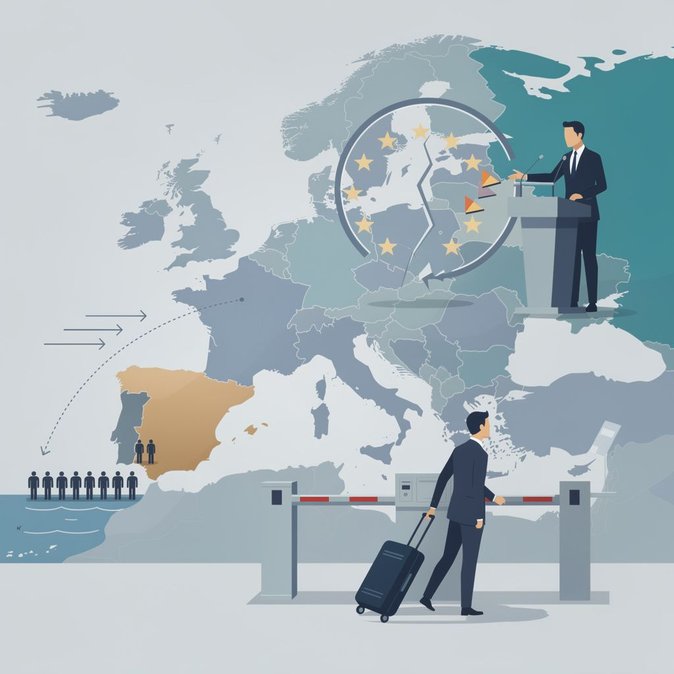
Finland’s hard-line Interior Minister Mari Rantanen (Finns Party) took to the social-media platform X on Friday, 31 July 2026, to demand that Spain be temporarily expelled from the Schengen free-movement zone after an estimated 49 000 migrants crossed into the Spanish enclave of Ceuta from neighbouring Morocco in just 24 hours. Rantanen wrote that Spain had “completely failed to protect the external border of the Schengen Area from infiltration” and called on other EU members to support Italian Prime Minister Giorgia Meloni’s earlier proposal to suspend Spain’s Schengen membership. She described the events as proof that “states which cannot guard Europe’s external border cannot belong to Schengen.” Rantanen’s intervention marks the most forceful public statement yet by a Nordic government on the Ceuta crisis, and it signals that migration management has become a front-burner political issue in Helsinki ahead of Finland’s municipal elections this autumn. While the minister’s comments do not constitute official Finnish government policy, they reflect the priorities of the Finns-led Interior Ministry, which has already tightened asylum rules, closed all but one land crossing with Russia, and floated the idea of a Nordic “return hub” for rejected asylum seekers. Practically speaking, a Spanish suspension would require unanimous approval from the other 25 Schengen states—an extremely tall order—but Rantanen’s warning raises the political stakes for Madrid. Finland’s leverage stems from its recent leadership role in EU border-security working groups and its vocal support for the forthcoming Entry/Exit System (EES) and ETIAS travel authorisation, both due to go live later this year. For multinationals, mobility managers, and travel teams, the episode underscores two risks. First, unilateral or bloc-wide border snap-backs remain possible, and contingency planning for intra-Schengen travel disruptions is essential. Second, rhetoric around “external border protection” is spilling into Schengen governance debates, increasing the probability of new ID controls at internal borders or ad-hoc visa scrutiny—even for business travellers. Companies moving staff through Spain, Finland or wider Schengen should therefore stay alert to shifting political sentiment, monitor airline and rail schedules for potential disruptions, and remind travelling employees to carry passports even on intra-Schengen itineraries. Immigration counsel should also be prepared for a possible cascade of compliance changes if Spain is formally censured or if other member states emulate Finland’s tough stance.
Source: Yle News