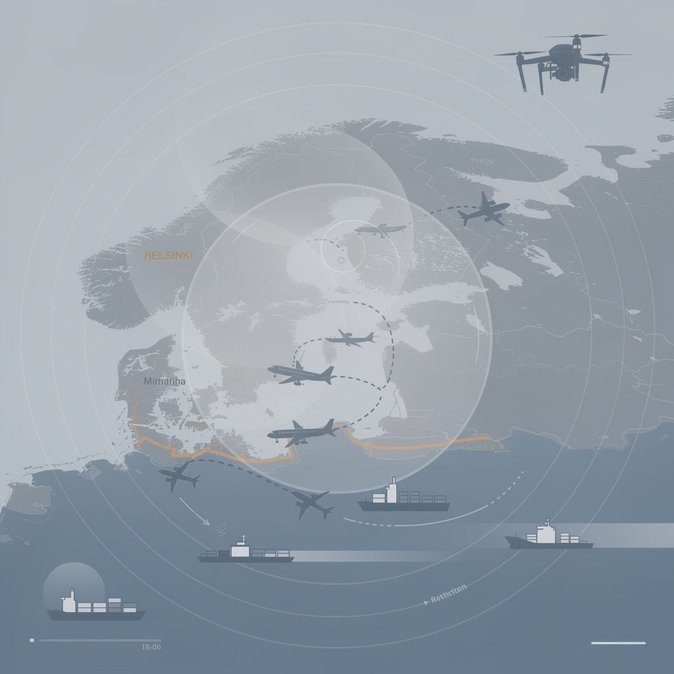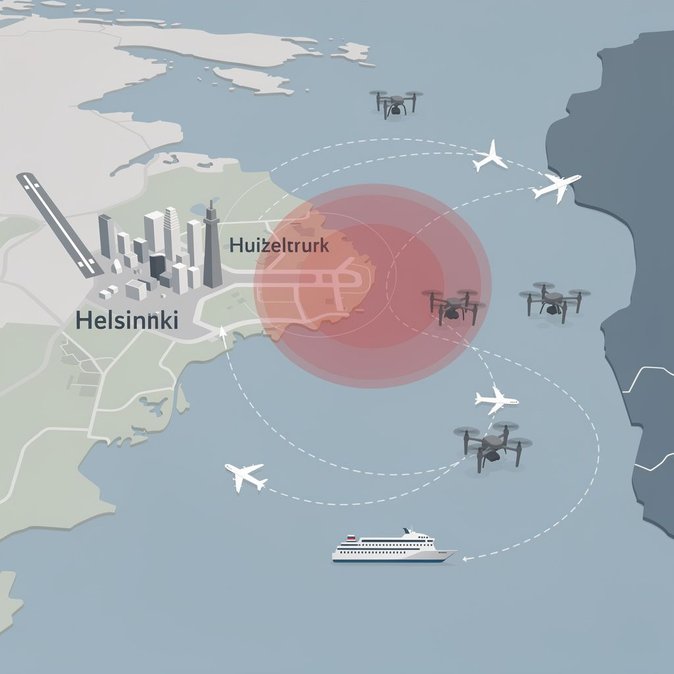
The Finnish Defence Forces (FDF) imposed an extraordinary restriction on Tuesday, 28 July 2026, closing a stretch of airspace and territorial waters between the port city of Loviisa and the Russian border from 08:05 to 10:30 local time. The measure, announced on the FDF’s X (formerly Twitter) account, was triggered by intelligence indicating that Ukrainian long-range drones aimed at Russian targets around St Petersburg could veer off course into Finnish territory. Within minutes of the alert, NOTAMs were issued and naval traffic advisories broadcast, effectively halting all civilian aircraft, scheduled ferries and commercial shipping in the eastern Gulf of Finland. Although the restricted zone covered only a narrow maritime corridor, its location—directly on the main approach path to Helsinki-Vantaa Airport and on one of Europe’s busiest Baltic Sea cargo lanes—had immediate ripple effects. Finnair diverted three early-morning passenger flights to Tampere–Pirkkala for refuelling, while Tallink Silja rerouted its Stockholm-Helsinki ferry 12 nautical miles south to international waters, adding almost an hour to journey times. The Port of Kotka temporarily suspended container loading, warning forwarders of potential same-day delivery delays to central Finland’s industrial parks. Finland has blocked segments of its airspace four times since May as Russia’s western military districts have come under increasingly frequent Ukrainian drone attack. Unlike previous closures, Tuesday’s order also suspended maritime traffic so that the Navy could, if necessary, engage any stray UAV with ship-borne jamming systems or surface-to-air missiles without endangering civilian vessels. Defence Minister Antti Häkkänen told reporters the decision reflects Finland’s “new NATO-era threat environment” and the government’s pledge to “shield critical logistics arteries and the freedom of movement of our citizens.” For global-mobility managers, the episode underscores Finland’s heightened risk profile along its 1 340-kilometre eastern frontier—even though the country remains outside the active combat zone. Companies moving personnel or high-value goods through the Gulf of Finland should review contingency routings via Sweden or Estonia, extend layover buffers at Helsinki-Vantaa, and ensure travel-risk insurance now explicitly covers drone-related disruptions. Multinationals operating just-in-time supply chains from Kotka and Hamina ports are advised to negotiate force-majeure clauses with carriers, as further unannounced closures are increasingly likely during periods of intensified fighting in north-west Russia. From a legal perspective, the shutdown was executed under Finland’s Border Guard Act and the recently-updated Drone Act, both of which grant the FDF exceptional powers to restrict movement for up to 24 hours without prior parliamentary approval. The Ministry of Transport and Communications confirmed that airlines and shipping lines will not be eligible for state compensation, classifying the incident as a force-majeure security measure rather than an infrastructural failure. Travellers affected can, however, claim EU261 compensation from carriers if total delays exceeded three hours—something Finnair says will apply to approximately 600 passengers on Tuesday morning’s services.
Source: SWI SwissInfo / EFE wire