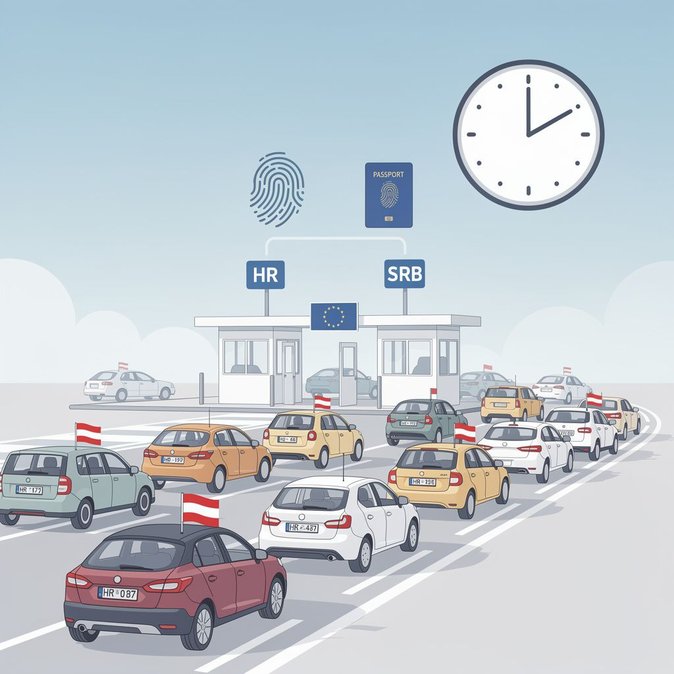
Austrian motorists heading south for the peak summer getaway this weekend were caught in tailbacks of up to seven kilometres at the Bajakovo-Batrovci crossing between Croatia and Serbia. According to eyewitness accounts gathered by the Associated Press, travellers reported waiting as long as eight hours in 35-degree heat on Friday and Saturday, 31 July–1 August. The jam coincided with the traditional 1 August holiday change-over and the first big test of the EU’s new Entry/Exit System (EES), which records biometric data for all non-EU arrivals and departures. While the crossing lies outside Austria, it is a critical corridor for tens of thousands of Austrian residents who drive to Croatia’s Adriatic resorts each summer or transit Serbia en route to Greece, Bulgaria and Turkey. Austria’s automobile club ÖAMTC urged drivers to avoid the A4/E60 Budapest–Zagreb route and instead consider the A1 through Slovenia or plan night-time departures. Vienna tour operator Gruber Reisen said several coach services from Graz and Linz arrived in Split and Zadar up to five hours late, forcing hotels to extend check-in windows and reorganise staff rosters. Travel industry representatives also warned corporate mobility managers to factor in border congestion when scheduling staff deployments to Southeast Europe. "We have pharmaceutical technicians who need to reach production sites in Niš on Monday morning; they now risk missing critical equipment calibrations," said Martin Bruckner, head of global mobility at an Upper Austrian biotech firm. Some companies have begun flying key personnel via Vienna or Ljubljana instead of relying on overland transport. Croatian border police blamed sheer traffic volume, but many travellers pointed to EES kiosks that appeared to freeze and require manual overrides. Although the system has been fully operational since April, several member states — including Austria — have temporarily suspended it during peak surges at airports. Neither Croatia nor Serbia indicated any such suspension at Bajakovo over the weekend. For now, consular officials in Vienna are advising citizens to carry extra water, allow at least half a day for border formalities and keep updated via the Croatian and Serbian traffic authorities’ live cameras. The episode is likely to intensify pressure on Brussels to introduce greater flexibility into EES procedures before the main Assumption Day travel wave on 15 August.
Source: Associated Press