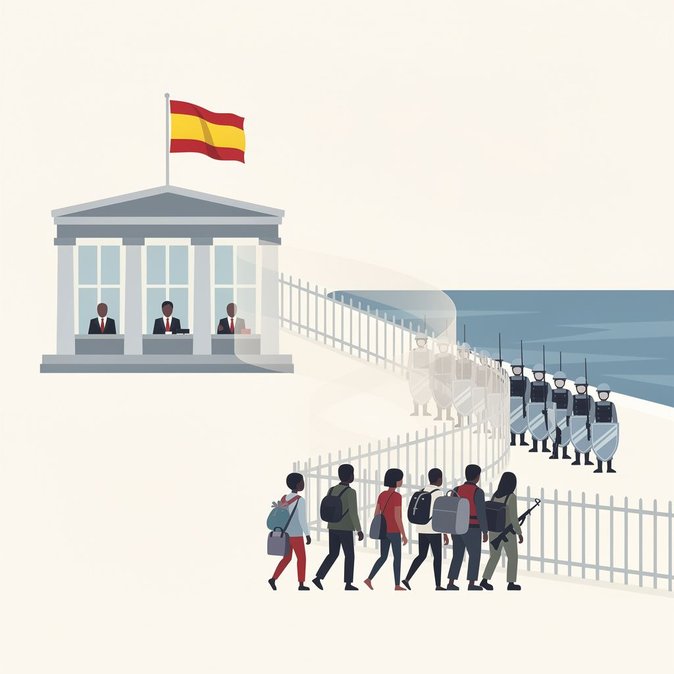
Spain’s lower-house plenary on Tuesday opened deliberations on two citizen-security bills, the most controversial of which—tabled by the right-wing Vox party—would amend the 2005 National Defence Law to classify irregular immigration as a threat that can trigger military deployments. Vox argues that Spain’s geostrategic location makes it a frontline state and that the July influx of more than 11,000 migrants into Ceuta exposed the limits of civilian policing. The draft legislation instructs the government to create a rapid-reaction military unit dedicated to external border protection, authorises the Navy to carry out ‘push-back’ operations in territorial waters and obliges regional authorities to hand over any migrants they intercept to the armed forces. Left-wing coalition Sumar immediately counter-proposed stricter curbs on speculative real-estate investment but also denounced Vox’s bill as unconstitutional. Interior-ministry officials told parliament that existing Guardia Civil and National Police deployments, backed by EU Frontex assets, already provide an “adequate and proportional” response. Defence Minister Margarita Robles warned that conflating military and law-enforcement roles could breach EU and NATO rules on civilian primacy. For global-mobility teams, the episode is a barometer of how Spanish politics is hardening on migration after the Ceuta crisis. Even if the bill is unlikely to pass in its current form, any future militarisation of borders would raise due-diligence obligations for companies sending staff to Spain’s enclaves or operating in the Western Mediterranean. The debate will continue in committee hearings next week; observers expect significant amendments or outright rejection. Businesses should monitor the legislative calendar, as sudden changes to Spain’s border-management architecture could alter entry procedures, humanitarian-visa pathways and enforcement intensity at key logistics hubs.
Source: RTVE