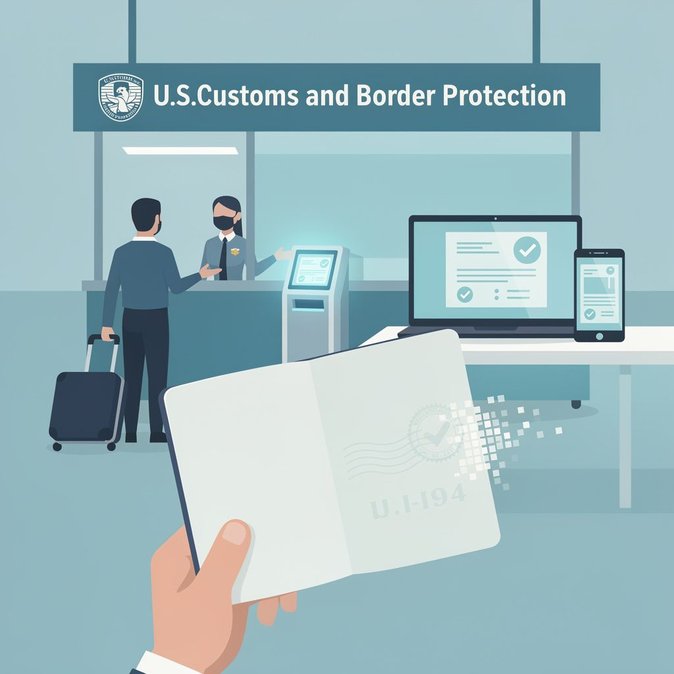
U.S. Customs and Border Protection (CBP) has quietly confirmed that front-line officers will no longer place an ink entry stamp in most travelers’ passports at primary inspection. The change, announced in an October 1, 2026 Carrier Liaison Program bulletin and reported on October 3 by VisaVerge, formalises a trend that began when CBP introduced the electronic Form I-94 a decade ago. Under the new practice, the electronic I-94—not the physical stamp—will serve as the official record of admission for the vast majority of foreign nationals entering the United States. For business travellers and global‐mobility managers the switch has two immediate implications. First, employees arriving on ESTA, L visas, or other non-immigrant classifications will no longer leave the booth with date-certain proof of status in their passport; HR teams will need to train travellers to download and save the I-94 from CBP’s portal or the CBP One app as soon as they clear the airport. Second, companies that rely on stamped passports for I-9 re-verification—or to trigger payroll localisation—will have to adjust internal processes quickly. CBP emphasises that travellers may still request a stamp and that officers retain discretion to stamp passports during secondary inspection, immigrant-visa endorsement and similar situations. Immigration attorneys, however, warn that secondary stamping is not guaranteed and advise stakeholders to treat the electronic I-94 as the single source of truth. Because Form I-94 occasionally contains data-entry errors, corporate mobility teams should build an automatic reminder for foreign employees to check the record immediately after arrival and to correct mistakes within 90 days. The agency did not publish a distinct nationwide “effective date,” suggesting the policy is in force immediately wherever ports of entry have the necessary infrastructure. Airlines and global travel managers should expect a brief period of mixed practice until every primary booth is configured to follow the new guidance. Ultimately, CBP says the move will speed up primary inspection, reduce paper waste and support its long-term goal of contact-less, biometrically verified border clearance.
Source: VisaVerge