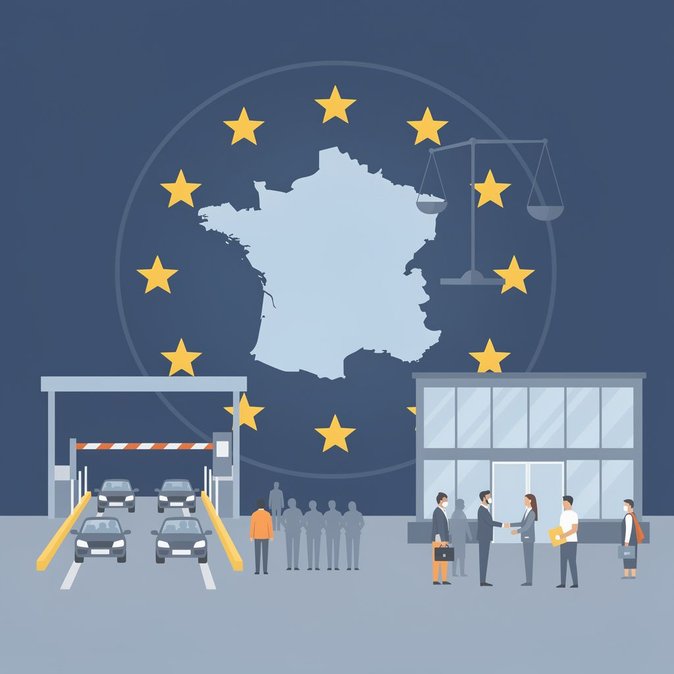
At midnight on 12 June 2026, the European Union’s long-negotiated Pact on Migration and Asylum formally became enforceable law across all 27 member states, including France. The wide-ranging package – adopted in 2024 but subject to a two-year implementation window – rewrites every stage of the EU’s migration playbook, from fingerprinting at the external frontier to the sharing of recognised refugees among member states. For France, the most immediate change is operational. All first-time irregular arrivals at the French land, air or maritime border must now be entered in the EU’s new biometric Entry/Exit System and channelled through a five-day security and vulnerability screening. Cases judged unlikely to result in protection will be fast-tracked in border facilities, while applicants with stronger claims move into the ordinary asylum procedure. The Ministry of the Interior has redeployed 450 border police and opened two additional screening sites at Paris-Charles-de-Gaulle and Menton to meet the new deadlines. Behind the scenes, Paris will also have to contribute to the Pact’s “permanent solidarity mechanism”. That mechanism requires each member state either to accept a relocation quota of asylum seekers (France expects roughly 9,000 a year) or to pay into an EU fund that supports border states such as Greece. The French Senate – where scepticism about mandatory sharing remains strong – must now decide whether to authorise relocations or approve an annual solidarity payment that Bercy estimates at €215 million. Large employers are watching the calendar, too. The new rules shorten labour-market access for asylum seekers from nine to six months, offering companies a potential – though temporary – talent pool in sectors from construction to elder-care. Corporate mobility managers should review onboarding processes to ensure that newly issued six-month work authorisations are captured in HR systems and that payroll complies with the Pact’s tighter reporting obligations. They should also anticipate heightened ID-check times at ports and airports this summer as guards learn the new biometric routines. By harmonising procedures and embedding digital security tools, Brussels hopes to reduce so-called secondary movements and restore confidence in the Schengen area ahead of next year’s full launch of the European Travel Information and Authorisation System (ETIAS). For France, the Pact is both a logistical test and an opportunity: success would allow Paris to argue that national deterrence measures can be scaled back, while failure could fuel calls for even tougher domestic controls in the run-up to the 2027 presidential election.
Source: Insight EU Monitoring