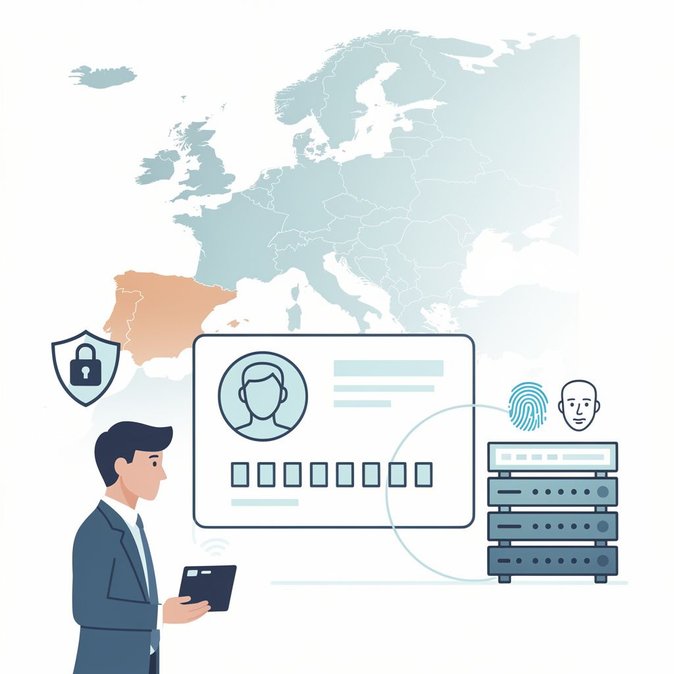
On 15 June the European Union quietly turned on its next-generation Eurodac system, adding facial recognition and wider interoperability with the Schengen Entry/Exit System and national asylum registers. Spain’s Interior Ministry confirmed that the country’s asylum offices and police alien units completed the first overnight bulk upload of historical fingerprints and face images at 03:00 CET on Monday.
Organizations and individuals who need to keep pace with Spain’s fast-moving immigration requirements can lean on VisaHQ’s end-to-end visa and document service; the platform (https://www.visahq.com/spain/) monitors regulatory updates such as the new Eurodac identifiers and helps applicants, employers, and HR teams file accurate paperwork, cutting delays and ensuring compliance.
Eurodac 2.0 extends data retention for asylum seekers and irregular border-crossers from 10 to 15 years and triples the number of searchable descriptors. For Spain, which processed a record 161,000 asylum claims in 2025, the change means every new applicant will have five biometric templates—two prints and one facial image—captured at the first appointment. Madrid argues the upgrade will speed up Dublin transfers and help detect ‘asylum shopping’. NGOs, however, fear the enlarged database could facilitate deportations under the new EU Pact on Migration and Asylum and increase data-protection risks. In practical terms, employers hiring refugees must now ensure that residence cards (TIEs) generated under the asylum channel show the new 16-digit Eurodac identifier. HR teams using older payroll software may need format patches to accept the longer number. Spain’s data-protection authority (AEPD) has opened a monitoring file to audit compliance; companies handling copies of employees’ TIE cards should review storage and deletion policies in light of the more sensitive biometric linkages.
Organizations and individuals who need to keep pace with Spain’s fast-moving immigration requirements can lean on VisaHQ’s end-to-end visa and document service; the platform (https://www.visahq.com/spain/) monitors regulatory updates such as the new Eurodac identifiers and helps applicants, employers, and HR teams file accurate paperwork, cutting delays and ensuring compliance.
Eurodac 2.0 extends data retention for asylum seekers and irregular border-crossers from 10 to 15 years and triples the number of searchable descriptors. For Spain, which processed a record 161,000 asylum claims in 2025, the change means every new applicant will have five biometric templates—two prints and one facial image—captured at the first appointment. Madrid argues the upgrade will speed up Dublin transfers and help detect ‘asylum shopping’. NGOs, however, fear the enlarged database could facilitate deportations under the new EU Pact on Migration and Asylum and increase data-protection risks. In practical terms, employers hiring refugees must now ensure that residence cards (TIEs) generated under the asylum channel show the new 16-digit Eurodac identifier. HR teams using older payroll software may need format patches to accept the longer number. Spain’s data-protection authority (AEPD) has opened a monitoring file to audit compliance; companies handling copies of employees’ TIE cards should review storage and deletion policies in light of the more sensitive biometric linkages.