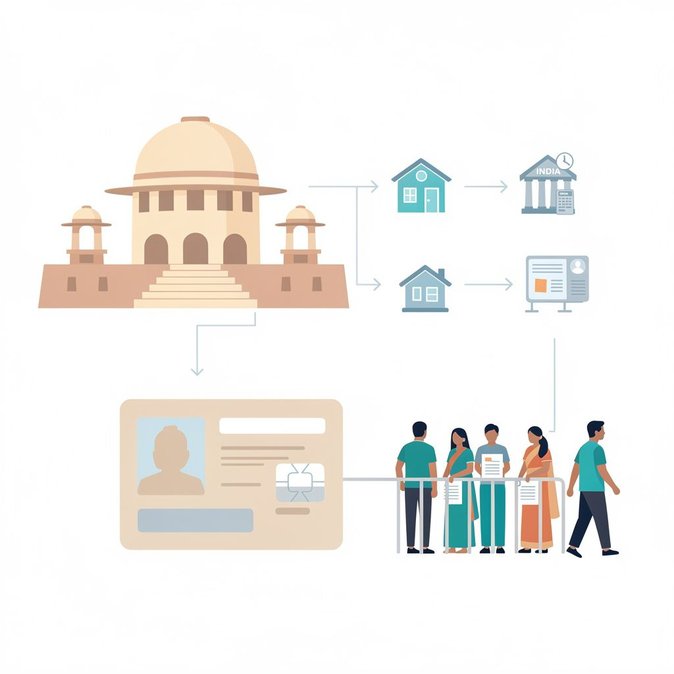
India’s Supreme Court on 16 June issued notices to the Union government, all states and the Election Commission after a public-interest petition alleged that Aadhaar cards are being misused as proof of citizenship, domicile and residential address. The bench headed by Chief Justice Surya Kant agreed to club the plea with earlier matters on the same issue and sought detailed affidavits within four weeks. The petitioner, advocate Ashwini Kumar Upadhyay, argues that the Aadhaar Act 2016 explicitly limits the 12-digit biometric identifier to “proof of identity” and that its acceptance as evidence of nationality or place of residence opens the door for undocumented foreigners to obtain voter IDs, ration cards and even passports.
Pointing to last year’s UIDAI circular that reiterated the same restriction, the plea calls for statutory amendments, tighter KYC protocols and a high-power monitoring committee headed by a retired Supreme Court judge.
Amid such uncertainty, organisations and individuals looking for reliable guidance on permissible travel and residence documentation can turn to VisaHQ, which tracks global entry requirements in real time and facilitates Indian visas and passports through its dedicated portal (https://www.visahq.com/india/). The platform’s compliance alerts and document-check services help HR teams and travelling employees ensure that the papers they present—whether Aadhaar, passport or visa—meet the latest legal thresholds, reducing the risk of rejection or penalty.
For mobility and immigration professionals, the case is significant. Aadhaar numbers have become an informal gateway document for everything from rental contracts to driver’s licences. If the Court ultimately restricts Aadhaar’s evidentiary scope, HR teams onboarding foreign employees, as well as banks carrying out customer due-diligence, may have to revert to more traditional documents such as passports, visas and long-term residence permits.
Corporates should watch for revised KYC guidelines, especially for employee housing, telecom and social-security enrolments.
Multinationals should also prepare for potential voter-roll purges or enhanced checks on expatriates married to Indian nationals.
While the Court’s final ruling could take months, today’s order signals judicial willingness to recalibrate India’s identity-verification architecture—an area that underpins both domestic service delivery and cross-border mobility.
Pointing to last year’s UIDAI circular that reiterated the same restriction, the plea calls for statutory amendments, tighter KYC protocols and a high-power monitoring committee headed by a retired Supreme Court judge.
Amid such uncertainty, organisations and individuals looking for reliable guidance on permissible travel and residence documentation can turn to VisaHQ, which tracks global entry requirements in real time and facilitates Indian visas and passports through its dedicated portal (https://www.visahq.com/india/). The platform’s compliance alerts and document-check services help HR teams and travelling employees ensure that the papers they present—whether Aadhaar, passport or visa—meet the latest legal thresholds, reducing the risk of rejection or penalty.
For mobility and immigration professionals, the case is significant. Aadhaar numbers have become an informal gateway document for everything from rental contracts to driver’s licences. If the Court ultimately restricts Aadhaar’s evidentiary scope, HR teams onboarding foreign employees, as well as banks carrying out customer due-diligence, may have to revert to more traditional documents such as passports, visas and long-term residence permits.
Corporates should watch for revised KYC guidelines, especially for employee housing, telecom and social-security enrolments.
Multinationals should also prepare for potential voter-roll purges or enhanced checks on expatriates married to Indian nationals.
While the Court’s final ruling could take months, today’s order signals judicial willingness to recalibrate India’s identity-verification architecture—an area that underpins both domestic service delivery and cross-border mobility.