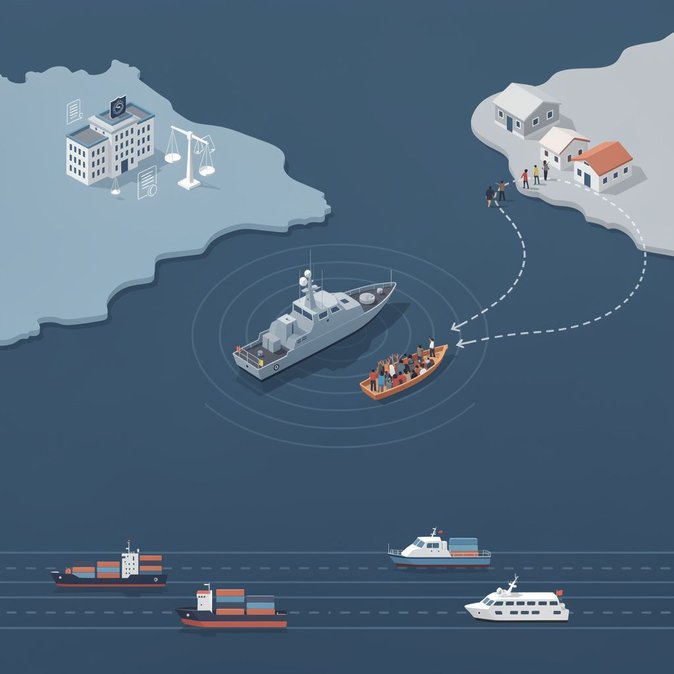
In a move that signals a tougher stance on irregular sea arrivals ahead of the peak summer crossing season, the Italian Council of Ministers approved a wide-ranging draft law on 16 June 2026 that rewrites key chapters of the country’s immigration framework. At its core is a provision that allows the Government to "interdict" entry into Italian territorial waters for up to 30 days—extendable in stages to a maximum of six months—whenever it considers there is a “serious threat to public order or national security.” Shipowners who ignore the interdiction risk fines of €10,000–€50,000 and, in cases of repeat offences, confiscation of the vessel. Crucially for global-mobility and human-rights professionals, the decree expressly permits people rescued or stopped at sea to be transferred to a “safe third country” with which Italy has an agreement—Albania is cited as the template. The text dovetails with the EU’s new Migration & Asylum Pact (fully applicable from July 2026) and draws on the recently enacted EU Regulation 2024/1359 on crisis situations, giving Rome broader derogations to accelerate procedures at the border. Beyond the maritime measures, the bill tightens rules for Italy’s network of expulsion and detention centres (CPR), introduces accelerated asylum-border procedures in line with EU standards, and expands the list of criminal offences that can trigger rapid removal. NGOs have already warned that restricting mobile-phone use in centres and pushing people offshore could collide with European case law on non-refoulement and access to legal assistance. For employers and mobility managers, the biggest operational questions concern timing. Although some articles will enter into force immediately after publication, others depend on secondary decrees that must be issued within six months. Companies with projects requiring non-EU talent—particularly in maritime logistics, offshore energy and port construction—should monitor territorial-waters notices, review evacuation protocols and prepare for stricter identity checks when chartering rescue or supply vessels. Politically, Prime Minister Giorgia Meloni has styled the bill as "a promise kept" to regain control of Italy’s borders, while the Interior Ministry argues that flexible interdiction powers are essential to avoid repeating the 2023 surge that overwhelmed coastal prefectures. Opposition parties and legal scholars counter that the proposal risks lengthy court battles similar to the 2012 Hirsi Jamaa ruling against Italy, potentially delaying implementation right as the EU’s own system is bedding in. Either way, the legislative process will be closely watched across Europe as a test case for how national governments intend to use the new EU Pact’s emergency clauses.
Source: La Sicilia